Hey folks, welcome to the first edition of another semi-regular feature, Lettercolumn Classics. You may recall that yesterday,
I announced my quest to earn the coveted title of Fearless Front Facer. I haven't yet heard back from Marvel, but our friends over at
Comics Should Be Good were kind enough to give us a shout out, so hopefully Marvel will take notice soon and I'll have an update. In the meantime, through a quirk of fate, the
thread on CBR about my quest has included some talk about old timey lettercolumns, which is a handy coincidence considering I was actually working on this new lettercolumn feature when I came up with the idea for my quest.

It's no surprise people are talking about lettercolumns, though, because while the advent of the Internet has mostly signaled the end of the printed lettercolumn (though a few upright souls such as Kurt Busiek and
Astro City continue to fight the good fight), for any comics reader of a certain age, the lettercolumn is a source of excitement and nostalgia. Indeed, once upon a time, the lettercolumn was actually the backbone of the hobby, as budding comic book fans would get addresses of other enthusiasts and trade back issues and ideas via snail mail, a practice that eventually formed the comics fan community as we know it.
Beyond the importance lettercolumns have as the foundation of comic collecting, though, they also serve as both a permanent historical record of what readers at the time thought of the comics and as an occasional source of amusement. Not bad for a feature that began simply to satisfy postal regulations. Back in the day, you see, comics had to include at least two all-text pages in order to qualify for the special shipping rate offered by the post office. In long ago days, that requirement was satisfied by prose short stories, until someone had the brilliant thought that simply publishing letters to the editor would be faster and cheaper.

The result? Classic lettercolumns like "Sock It to Shellhead", "Let's Rap with Cap" and "Let's Level with Daredevil" were born. Okay, so the late 60's were weird even in the world of lettercolumns, but it's no exaggeration to say that they served not just as a means of fan expression but also as an important launching point for the careers of many pros. Busiek himself first came to Marvel's attention through his letters, for example, while Mark Evanier's letter to Stan Lee suggesting ceremonial titles for fans ended up published in Stan's Soapbox and led to the classic blurb, "Know Ye These, The Hallowed Ranks of Marveldom" that ran throughout the company line and inspired my quest for the F.F.F. honorific. And sometimes romance even bloomed; future
Elfquest creators Wendy and Richard Pini, for example, first met through the
Silver Surfer lettercolumn.
Lettercolumn Classics, then, will be taking a look at some of the letters, great and not-so-great, that have graced the pages of comic books over the past 60 years or so, presenting slices of life from a bygone age. Today we kick off our feature with a look at a couple letters from one of the more interesting lettercolumns of the day,
Sgt. Fury.
Though all of Marvel's titles in the 60's were known for having comparatively more progressive exchanges between the readers and the editors than their competitors,
Sgt. Fury in particular was a lightning rod for controversial letters, which on some levels is to be expected considering our nation's involvement in the Vietnam War began (and eventually ended) during the title's long run. But before that there was another, much more surprising controversy that raged for years within the lettercolumn of
Sgt. Fury as readers continually wrote in to complain about the treatment of Germans in the comic.
That's right. Hard as it is to believe now, in the early-to-mid 60's, a significant portion of the fan base was upset at the fact that German soldiers were being depicted as the bad guys in a World War II comic! Specifically, many of these letters were defending the average German soldier as compared to the Nazis. These letters would typically go along these lines: all Germans weren't Nazis; therefore it's wrong to depict them all as evil; and even worse to show them as being incompetent; so Marvel should show some good German soldiers just doing their duty defending their homeland.
Of course, to modern sensibilities (such as mine) this is kind of boggling considering most of the "defending" was taking place on occupied land taken by German aggression. Yet, though Stan in particular often shot these ideas down with some vigor in the lettercolumn (often using a variation of the line "If the Germans want to publish a war mag where they are the good guys they can, but as long as we're publishing them, the Americans will be the good guys"), Marvel was sensitive enough to the fan viewpoint that Roy Thomas eventually introduced Eric Koenig, a good German soldier who, rebelling against the Nazis that had taken political control of his home, defected to the Allied side and joined the Howling Commandos (and later SHIELD). Here's a typical example of one of these letters and Stan's response:

The most amazing episode of this heated debate, though, came after Koenig's debut (and ironically in the same issue, #35, where Koenig defected to join the Howlers). In the lettercolumn of that issue, another voice weighed in on the debate, but this time from a unique perspective. Because this writer, you see, happened to actually be a former S. S. officer!
Here's the letter and Marvel's response:


While Marvel sidestepped this landmine, other readers were eager to take up the argument, and in
Sgt. Fury #40 Marvel published the following letter from another reader, which we suspect was selected because it probably came closest to Marvel's own thoughts on the matter. It also happened to express those ideas in a particularly eloquent manner:

For all intents and purposes, the introduction of Koenig and this spirited exchange in the lettercolumn spelled the end of the debate over Marvel's characterization of German troops during World War II. Of course, the times being what they were, this was in part because by this point America's involvement in Vietnam had become significant and the letters increasingly turned to focus on Vietnam instead.
But while there are plenty of interesting letters about Vietnam not just in
Sgt. Fury but in all war comics of the time -- indeed, I suspect someone could write an interesting book about the topic and how changing attitudes towards war comics shaped the industry and eventually led to war comics almost disappearing entirely as a genre -- those letters will have to be the subject of a future episode of Lettercolumn Classics.
Next Time: From a literal war to a culture war, we shift gears, as the next installment of Lettercolumn Classics takes a look at
The Cat and how readers responded to Marvel's version of Women's Lib. Be there!

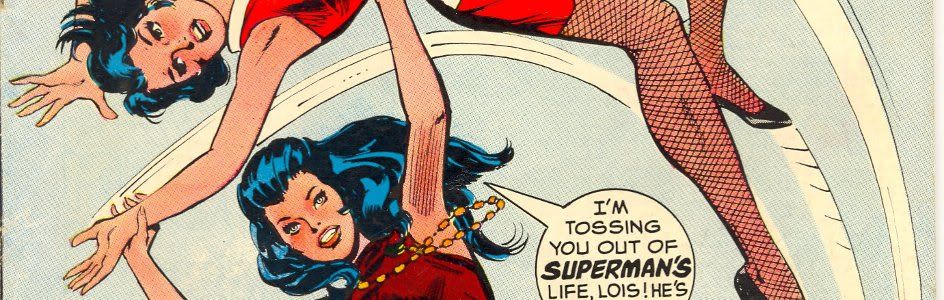
 Welcome back to another installment of Lettercolumn Classics, our semi-irregular look at some of the more interesting and offbeat lettercolumns in comic history. Last time out, you may recall, we explored the strange debate in the pages of Sgt. Fury about the treatment of German soldiers in Marvel comics (check it out here). Today we take a look at another hot button issue: women in comics.
  Or, specifically, women in comics in 1972. That's when new Marvel editor-in-chief Roy Thomas came up with one of the riskiest, most innovative and most progressive initiatives in comics: a whole mini-line of comics featuring female characters and written and drawn by female creators with the idea of both expanding the role of women in the industry and drawing in girls and women who may not otherwise be reading comic books.