Game Review: Diablo 3

Diablo 3 is out. But is it a game? Or is it the most brilliant money making scam in internet history?

Movie Review: The Avengers

Okay, okay, I posted my Avengers review. Get off my back already, geez.

The Most Important Comic Book You've Never Heard Of

Action Comics #1. Detective Comics #27. Why is All-American Men of War #89 as important as these great comics -- and why have you never heard of it?.

Tales From the Vault: Lois Lane #93

If you thought Superman was a total tool before, you ain't seen nothing yet.

Mass Effect 3: The Official Review

Mass Effect 3 isn't the end of the world, it just portrays it.

Tuesday, August 10, 2010

The Top 150 DC Covers of All Time: #140-131

Welcome back to the Top 150 DC Covers of All Time countdown. If you have any questions about what criteria was used to select the covers, you can read the ground rules here in the countdown Prologue. For a complete listing of selections, check out the Top 150 DC Covers Master List. And as always, I strongly recommend clicking on the covers to see larger, better and more detailed versions of these classic covers.

Now, let's see what Day Two has in store for us:


140) Our Army at War #15
October, 1953 -- Irv Novick

This gem from the early days of DC's Big Five war books features typical guns-blazing action with some very atypical -- and shockingly bold -- coloring and inking. The dramatic fire on board this bomber gives Novick a chance to really play with the lighting and he does it to great effect; the fact that you can see the gunner behind him still firing at attacking fighters just adds to the tension. You almost feel like you might crash the plane yourself if you set down the comic.


139) Batman Family #17
May, 1978 -- Michael Kaluta

"Stalk the night shrouded streets with The Batman Family... if you dare!" Well, DC, when you put it that way, I think I'll just hide under my bedcovers instead, thank you very much. Luckily, Kaluta was able to contain his own fear long enough to provide this (literally) all-star look at the members of said Batman Family. Even the somewhat blah barbell masthead for the $1 comic line doesn't detract too much from this well-designed effort.


138) Wonder Woman #179
December, 1968 -- Mike Sekowsky and Dick Giordano

In an attempt to jump start some of their more hidebound heroes to counteract marvel's surging sales, DC revamped several icons in the late 60's including Wonder Woman. The cover for the first new issue, #178, is a fairly boring affair, but the real revamp is seen in full effect on this great cover from Sekowsky and Giordano.
The great new era logo, which replaced one of the least interesting logos in DC history, really sends this effort over the top.


137) Justice League of America #62
May, 1968 -- Mike Sekowsky and Jack Abel

Speaking of Sekowsky, here's one of his best and most unusual covers. it's like the end of Seven, except you yourself are the severed head in the box. It's disturbing. And I love the expressions on the Justice Leaguer's faces. The whole thing is creepy and disorienting. How could you not buy this comic if you saw it on the stands?


136) Green Lantern #40
October, 1965 -- Gil Kane and Murphy Anderson

Kane returns with his second Green Lantern cover so far (but not his last), this time also featuring the golden age Green Lantern, Alan Scott. This is a key issue, not just for the meeting of the two Green Lanterns, but also because it reveals the origins of the Guardians of the Universe for the first time. That might be enough by itself to land the comic on our list, but luckily, it's graced by some typically smooth and fluid figure work by Kane, who drew some of the most limber and graceful heroes in comics history.


135) G. I. Combat #130
July, 1965 -- Russ Heath

Surprisingly enough, this well known cover from the Haunted Tank strip in G. I. Combat wasn't done by the usual suspect, Joe Kubert, but instead by longtime pro Russ Heath. The colorist here wisely decided to go with a monotone hue to make the giant, ghostly image of Attila the Hun seem almost translucent against the red background. A striking image made even more striking by its total incongruity (which, by the way, I addressed in an earlier edition of Ask the Vault if anyone is interested).


134) Teen Titans #23
October, 1969 -- Nick Cardy

Less than a year after Wonder Woman got the reboot treatment, Wonder Girl followed suit with this cover from Nick Cardy. Donna Troy's new design was as modern and forward as the design of the Teen Titans book in general at the time; while not as dramatic an overhaul as the new kung fu Wonder Woman, this hip and fresh take Wonder Girl made her significantly more relevant to teens of the day (and as a result, this new version was quite a bit more successful overall than Wonder Woman's revamp). I also like the nod to DC history of having Donna jumping through a poster of herself, which echoes the tradition of having new characters leap through a paper hoop like circus animals. Very nice.


133) Superman #307
January, 1977 -- Neal Adams

Don't look now, but here's the first of our slew of covers from Neal Adams. By the time Adams did this cover in 1977 he was no longer a regular cover artist for DC, but he clearly didn't miss a beat over the years. The design of this cover, with Supergirl so far in the foreground that most of her body is off the page, helps frame the shocking image of Kandor being smashed to hell and Superman's horrified reaction in the background. Excellent composition.


132) All-Star Comics #3
Winter 1940-41 -- Everett E. Hibbard

DC's version of the knights of the round table gather here for the first time to form the first superhero team in comics history. I like the nod to the concept of having them sit around an actual round table, and the classic All-Star Comics logo in front of the bright yellow background is great. The figures may just be sitting there, but they also seem like they're ready for business as they stare out at the reader. And I don't even mind the big text box roll call at the bottom either, though you have to feel bad for Johnny Thunder, as he made the list but not the team or the cover. And thus was fated to be a second banana forever. Poor sap.


131) Weird War Tales #8
November, 1972 -- Neal Adams

Another Neal Adams effort and one of many covers I decided to include before I realized they were actually drawn by Adams. What I like best about this Weird War cover is the design decision to drop the logo down from the top of the book so that the giant golem thing is peering out over the top of it. This really emphasizes his height and makes him a lot scarier than if they had redrawn the cover to allow the cover to stay at its usual place up at the top of the cover. Honestly, it makes the whole thing and turns this from just a cool image into a true top notch cover.


Tomorrow: #130-121! Romance! Horror! War! And more Neal Adams! Plus: the death of a hero! Be there!


Bookmark and Share

The Top 150 DC Covers of All Time: #150-141

Welcome to the first day of our hotly anticipated Top 150 DC Covers of All Time countdown. If you have any questions about what criteria was used to select the covers, you can read the ground rules here in the countdown Prologue. For a complete listing of selections, check out the Top 150 DC Covers Master List. And as always, I strongly recommend clicking on the covers to see larger, better and more detailed versions of these classic covers.

On with the show!


150) Justice League of America #9
February, 1962 -- Mike Sekowsky and Murphy Anderson

It's one of the most iconic images of the early Justice League (and Silver Age DC Superheroes in general): the heroes of the JLA slowly being transformed into trees by an alien meteorite perfectly embodies the spirit of those early Gardner Fox stories. The only reason it isn't higher on my list is that there are several other covers from the same time period that are also famous for basically the same reason. But this is still a cool cover.


149) Our Fighting Forces #130
April, 1971 -- Joe Kubert

While The Losers in Our Fighting Forces isn't as well known as Kubert's efforts on Enemy Ace or Sgt. Rock, it does feature some of his most innovative cover work. That's because, as you can see in this moody example, from #125-141 the series didn't have a logo; instead, Kubert worked a new Losers masthead into each cover, specially designed to mesh with the artwork. All of these are awesome, especially the bomb logo on #127, the sail logo on #139 and the ocean logo on #132 (which nearly made the list), but this cover, which also features a classic Kubert "trap about to spring," is my favorite.


148) Wonder Woman #72
March, 1993 -- Brian Bolland

This image of Wonder Woman by Brian Bolland was instantly iconic; from the moment it was published, it was hailed as one of the most powerful depictions of Wonder Woman ever produced. I have to admit, the hair is just a touch 90's for me, but that's a tiny nitpick; this is a strong, powerful and sexy Wonder Woman. What else do you want?


147) The Brave and the Bold #28
March, 1960 -- Mike Sekowsky and Murphy Anderson

The first appearance of the Justice League of America, this otherwise kind of boring cover is greatly enhanced by the central presence of Starro the Conqueror. I mean, he's a giant pink alien starfish with a target in the middle. That's a striking image, and of course, this is an important comic, which has led to this being iconic despite its artistic shortcomings. It's not the best Starro cover ever (see: Justice League of America #190) but it deserves a place on the list.


146) Girls' Love Stories #60
February, 1960 -- Bob Oksner (?) and Bernard Sachs

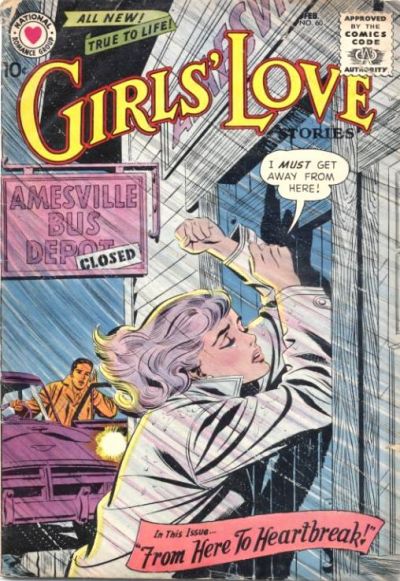
I'm not actually sure who penciled this cover (Oksner is the best guess the experts over at CBR could come up with), but it's a great example of compressed storytelling; the cover itself has a whole story to tell without ever even cracking the pages. The moody rainstorm, the woman pounding on the door, the bus dept sign, the guy in the background coming out of his car -- it's all perfectly designed and executed. How could you not want to read this comic after a tease like that?


145) Superman #75
January, 1993 -- Dan Jurgens and Brett Breeding

I don't like this cover. I've never liked this cover. And, not to put too fine a point on it, I will never like this cover. It's blocky and angular and just... ugh. I hate this damn cover. However, there's no arguing that it's one of the most iconic covers of the past two decades, not to mention in this history of Superman -- which is saying something. Millions of people who have never read a comic know this image from the media coverage surround the Death of Superman storyline. So despite my undying loathing of this cover (by Dan Jurgens, whom I usually love) I had to include it. Blah.


144) Showcase #22
October, 1959 -- Gil Kane

The first appearance of Hal Jordan, this impeccably executed cover has all the elements to be a great cover -- nice, clean design, dramatic composition and smooth figure work from Kane that still looks modern over half a century later. In fact, given all of that as well as the importance of the issue, it seems like this cover should be a lot more exciting than it actually is. I think this is a cover that everyone appreciates but nobody really loves, you know? This is one cover that logically deserves a higher ranking but just kind of falls flat for reasons I can't explain.


143) DC Super Stars #11
January, 1977 -- Gray Morrow

There are a few things I like about this cover beyond Zatanna's fishnets (which, I might add, aren't even the best fishnets to appear on our list). I like how the text curves around Zatanna's bubble to help emphasize the shape of the cover; and I also like the monochrome demons swarming over her shield, though I do wish they had picked a bolder color for them instead of that godawful hue they used. Overall, though, this cover and its one-off "Magic" logo are a high point of the late 70's, an otherwise desolate wasteland for DC covers.


142) House of Mystery #277
February, 1980 -- Steve Ditko

Nine out of ten dentists agree that this is the creepiest Ditko cover of the last thirty years. It's a shame that Ditko turned into an addled hermit, because this cover shows that he still could put out awesome work when he wasn't composing manifestos on a pre-war typewriter. Thanks to the comparatively advanced printing and coloring available in 1980, this is also one of the cleanest looking Ditko covers you're going to find. It's a shame we didn't get more stuff like this.


141) Flash Comics #1
January, 1940 -- Sheldon Moldoff

A legitimate milestone in comics history, Flash Comics #1 is woefully ignored compared to comics like Action #1 and Detective #27. This comic is not only the first appearance of Flash, but it's also the first appearances of both Hawkman and Johnny Thunder. And it features a nice cover by Shelly Moldoff, who was turning out some fantastic stuff in the 1940's. His best work, though, came on his intricately detailed Hawkman covers (later issues of Flash alternated between Flash and Hawkman covers). So as much as I enjoy the design here (yellow cover! little circles with tiny other characters in them!), the unwarranted anonymity of this cover relegates it to a lower slot than it might deserve.


Tomorrow: #140-131! Teen Titans! Haunted Tank! And the first of many, many Batman covers! Be there!


Bookmark and Share

His Name... Is Gideon Cain

Hey folks and lady folks. By this time you are no doubt pretty much thrumming with anticipation like a tuning fork over the teasers I've been posting regarding The Vault's upcoming second anniversary launch feature. And that's to be both expected and admired. But before we get to that excitement (in just two more days!) I thought I'd interrupt things for a moment to mention a little something by the name of Gideon Cain.


Chances are you're not yet familiar with Gideon Cain, which makes sense because until this morning, pretty much nobody outside of the folks working on it had ever heard of it. So here's the scoop: co-created by Official Friend of the Vault Kurt Busiek, Gideon Cain is a Puritanical demon hunter who roams the late 17th-century world searching for evil to stomp flat. And now he's starring in his first anthology, Gideon Cain -- The Demon Hunter, which is being published by the indie pulp masters at Airship 27 and which was edited by Official Friend of the Vault Van Plexico.

As it happens, one of the stories in Gideon Cain -- The Demon Hunter was written by yours truly. Hence, you know, this announcement. I haven't yet had a chance to read any of the other stories, so I'm looking forward to picking up a copy myself, but if you also want to sink your face deep into the bosom of pure darkness, you can start by ordering a copy of the book from this website, which also features some of Airship 27's other pulp offerings.

So check it out and let me know what you think. And if you're still not sold for some crazy reason (which I find hard to believe), here's the offical press release from Airship 27 about the book. Enjoy:


"Airship 27 Productions & Cornerstone Book Publishers have teamed up with noted fantasy, science fiction author, Van Allen Plexico to bring to life a brand new sword wielding adventurer; Gideon Cain – The Demon Hunter. Originally conceived on an internet forum, this swashbuckling, globe trotting avenger is the result of half a dozen creative minds pooling their ideas and imaginations into bringing forth a tortured hero cast in a classic pulp mold.

"During the famous Salem Witch Trials (1692-93) British born Puritan soldier, Gideon Cain aided the inquisitions, believing them to be just. Soon thereafter, God revealed to Cain that he and the righteous citizens of Salem had been duped by a cunning, ageless demon from Hell known as Azazel. The guilt of his actions weighs heavily on his conscience and rather than be driven mad by it, Gideon chooses to make atonement. Taking up his sword, the blade inscribed with holy runes, he bids farewell to his wife and children and departs on his sacred mission. Now he wonders the earth doing God’s work and destroying evil in whatever shape or guise it appears; his one consuming goal, to find and destroy Azazel.

"Airship 27 Productions is thrilled to be bringing pulp fans this great new character written in the tradition of Robert E. Howard’s Solomon Kane. Here are seven exciting, action packed tales of the Demon Hunter by Scott Harris, Brian Zavitz, K.G.McAbee, Ian Watson, James Palmer, David Wright and Van Allen Plexico. Design and interior illustrations by Art Director Rob Davis with a painted cover by Davis and Shane Evans.

"The book also features a special introduction by co-creator, Kurt Busiek. (Marvels – Astro City)

"Airship 27 Productions, Pulp Fiction for a new generation.


ISBN: 1-934935-74-3
ISBN 13: 978- 1-934935-74-3
Produced by Airship 27
Published by Cornerstone Book Publishers

Release date: 08/13/2010"


Bookmark and Share

Monday, August 9, 2010

The Top 150 DC Covers of All Time: Prologue

Aaaaaand we're back. Yes, a year after rocking the internet world with The Real Top 70 Marvel Covers countdown, The Vault (which means, you know, me) is back with an exponentially larger feature: The Top 150 DC Covers of All Time. Yes, 150 isn't technically exponentially more than 70 -- that would be, like 4900 covers or something -- but the task itself was vastly more difficult, given the fact that DC has been the nation's number one comics publisher for decades and as a result has vastly more covers to go through than Marvel.

But that's exactly why I wanted to take a shot at ranking DC's incredible output. Because, let's face it, DC has put out some of the greatest comic book art of all time and not just in superheroes, but in every possible genre, from mystery to fantasy to romance, from westerns to war to teen humor. It's really an incredible output covering the entire history of comics, featuring art from the greatest artists of all time.

For the next fifteen long-ass days, then, we'll be counting down the Top 150 Covers in DC history as determined by a panel of experts: me, myself and I. Like last time, I did my best to incorporate the views of others in order to make this as fair and balanced a list as possible. In particular, the folks at the Comics Should Be Good blog and the CBR forums deserve recognition, as I've been informed and enlightened by their opinions and expertise on DC comics over the past year while this list has been fulminating. Having said that, unlike my Marvel list, there doesn't seem to be nearly as much consensus or discussion regarding DC covers, meaning that this list is by necessity going to reflect my personal opinions even more than the Marvel list did.

So what makes up a "Top" cover as opposed to a "Best" or "Most Iconic" cover? "Top" is a nicely nebulous term that for my purposes encompasses both of these factors and more, as in some ways I'm comparing apples to oranges when trying to weigh the merits of a superhero cover from 1940 against a sci-fi cover from 1955, a romance cover from 1964 and a horror cover from 1971.

Here, then, are the basic criteria I used for this list, tweaked slightly from when I did the Marvel countdown:

1) Iconography. Some covers have transcended the actual image on the cover or the importance of the story within the comic to become iconic images. This can happen for several reasons – the first appearance of a major characters, the story within the comic, the issue’s collectability or just the beauty of the art itself – but the result is that the cover has become iconic not just to readers of that book, but to comic fans in general and in some instances to the public at large. If I felt a cover was iconic, I gave it more consideration than other covers of similar design or attractiveness that are not as well known.

2) Importance. This ties in to the first criteria, but some stories are so important for one reason or another that the cover image becomes ends up becoming iconic as a result regardless of artistic merit. When researching the choices, there were some covers that I personally didn’t feel were particularly great images or designs but which other comic fans cited over and over again as being a top cover primarily due to the importance of the events in the comic. Many first issues, first appearances or character deaths fall into this category.

3) Popularity. No, it's not the end all and be all, but how popular a cover is directly ties in to some of the other factors here. What makes a cover iconic or memorable, after all, is mainly the visceral response it (and the story inside the book) provokes in the reader. So while I don’t personally love all the covers on the list, I did try to incorporate other opinions and spent a good deal of time reading different messages boards and studying other people's lists (to the limited extent that I could) to see just which covers really are widely popular with the greater fanbase.

4) Art and Design. Some covers aren’t necessarily important or iconic but are so beautifully drawn that they merit inclusion on the strength of the art and design alone (though it should also be noted that some covers have also become iconic solely because of their artistic merit). Of all the criteria for my list, this is the most subjective and there are a handful of covers on my list that are basically personal preference. I tried to be as objective as possible when compiling this list, but art defies objectivity, so this cannot and perhaps should not be avoided. Whenever a cover made it on to my list solely through personal preference it will be noted in my comments. Though this is the last of the four major criteria I'm listing, it's actually the most important to me personally.

In addition, before we get started, there are a few notes specific to this DC list I'd like to mention. Firstly, as I was compiling the list, it became apparent to me that, as I suspected, DC has generally been much more bold and experimental with its designs than Marvel. Part of this, of course, is as a result of Marvel's competition; it should come as no surprise that the two periods with the most creativity in terms of cover design were the early Golden Age, when DC was still competing with a wide array of other publishers for industry dominance, and the Bronze Age -- roughly 1967-1974 -- when DC had to react to Marvel's sudden market surge. As a result, those two periods, particularly the latter, have much greater representation than other, more stagnant design eras (particularly the period from 1946-1967 when DC, safe at the top, locked into an extremely stagnant and boring design aesthetic).

One side effect of this imbalance is the unmistakable dominance of one artist, Neal Adams. Adams has two major things going for him. Firstly, he's justly revered as one of the greatest comic book artists -- particularly in cover design and execution -- ever. And secondly, the period of his greatest output coincided with Carmine Infantino being named art director in 1967. This meant that Adams (and the other artists) essentially had free reign to experiment with design elements, and Adams in particularly was massively prolific, providing dozens of covers for every genre DC was publishing, many with envelope pushing designs. So you'll be seeing a lot of him for those reasons.

On the flip side, there are three things you won't be seeing much of -- or any of -- on this list. The first is modern comics. The main strike against putting them on a list like this (though there are a few that snuck in and I did review most of them) is simply that they are, by definition, new, meaning that it's too early to say just which covers will end up being memorable or iconic once enough time has passed to judge such things, which I generally think takes a good 10-15 years at minimum. This is further complicated in my opinion by modern coloring techniques. While classic four color comic books may have been simplistic compared to today's excellent coloring, those simpler colors also provided the side effect of strengthening and highlighting the composition and design of a cover, whereas today's more subtle coloring techniques do just the opposite, often obscuring and muddying composition in service of muted tones and gradients. The result is that many modern covers, while individually beautiful and expertly rendered, are not particularly memorable; they tend to blend together. Good? Yes. Memorable? Not necessarily.

This actually is not quite as true for DC as it is for Marvel, thanks to the fact that DC is much more experimental with their design work. But that is mostly thanks to their groundbreaking Vertigo imprint, which brings me to the second thing you won't be seeing on this list: Vertigo Comics. I had originally intended to include them; however, after studying their output, I came to the conclusion that Vertigo's aesthetic was so inherently different from almost everything else DC has done that it needed to be considered separately. Comparing apples to oranges is one thing, but this would be like comparing apples to dominoes. At some point I hope to do a separate top cover list for Vertigo so we can look at some of the awesome covers they have been doing over the past 20 years, but for this list, I had to leave them off. [This also caused some issues in terms of titles like Hellblazer and Swamp Thing, which started at DC and switched to Vertigo. it's a little complicated but essentially I decided to leave those titles off the list entirely and treat them as Vertigo in their entirety]

And for similar reasons, I also left off DC's pre-hero covers. While some people seem to be under the impression that early Golden Age art is sub-par, the opposite is true; DC's mid-30's, pre-hero covers feature impeccable art from some of the best magazine illustrators of the time. But they also are completely different in style, tone and substance than anything DC did once superheros came into existence, so I decided to leave them out and look at them closer another day.

But, anyways. That's a whole ton of talk with not nearly as much action. Or Action. And after reviewing 10,000+ covers, I'm ready to actually show some of them now. So without further ado, let's stop the chit-chat and get to it: The Top 150 DC Covers of All Time.


Tomorrow: #150-141. The Justice League of America! Wonder Woman! Zatanna! And more! Be There!

And you can check out The Top 150 DC Covers of All Time Master List here.


Bookmark and Share

Sunday, August 8, 2010

The Vault's First Anniversay Flashback

Just one short year ago, your lives, and the lives of everyone you know, have known or will ever know, changed in an instant when The Vault went live. Yes, it's true: a year ago today, August 8, 2009, The Vault premiered with an introduction and three brief articles highlighting new comics, old comics and one of the worst summer blockbusters of the year, G. I. Joe (which was still better than anything Transformers has yet put on celluloid).

That means that today, of course, is The Vault's first anniversary, so in order to celebrate one year of comics, movies, random opinions and internet meltdowns (for a fairly impressive total of 203 posts), we're going to have a collective Flashback where we look back at some of the highlights and lowlights of The Vault's first year, while also peeking into the future to see what might be coming up on the horizon.

If that sentence was too long for you to navigate, don't worry: the juice is about to flow, so sit back and take a trip down memory lane with The Vault.


Special Features
While I've tried to provide some interesting recurring features for people to get invested in and look forward to (with varying degrees of success, as we shall see momentarily), most of my most popular posts have been special features, either one-shot essays or week-long events. Not all of these have been massive successes -- I was expecting a lot more interest in my groundbreaking essay Hawkeye Is Not A Whore, for example, and my In Defense of Fanboys rant fell on deaf ears, while I mangled the execution of my planned series on Comic Book Weddings -- but for the most part, the special features I've highlighted from time to time have been the most popular and debated content on The Vault.

With that in mind, here's a look at some of the most popular Special Features of the last year, with commentary where applicable.

6) Quest for the FFF -- This was a bit of a mixed bag for me. I had originally hoped to turn this into a long-running, ongoing series, where I would hopefully be tasked by Marvel with missions in order to achieve the title of Fearless Front Facer; I thought this would be a fun way to incorporate some video onto my site and build up a bit of an audience as well. I got a ton of hits the first couple days, but Stan Lee doesn't mess around; he ended up giving me the title after about two days, putting the kibosh on my grand plans. Still, getting an email from Stan Lee was pretty awesome.

5) Marvel's Great Licensing Experiment -- This was the first weeklong feature I did; focusing on Marvel's licensed properties like Rom, I explored how they interacted with the Marvel Universe as a whole for better or for worse. I still get readers occasionally who found the site looking for information on Rom.

4) Presidents in Comics One of my more esoteric efforts, this overview of presidential appearances in comics books. There are really too many to give as much details as I would have liked, but I'm pretty happy with the results. I also got a massive boost in hits because of this, when some Tea Party crackhead decided to attack Captain America #602; in the resulting debate, someone linked to the section about Ronald Reagan in comics, and I received nearly a thousand visitors in one day.

3) The Greatest Avengers Stories Ever Told -- A subject near and dear to my heart, this was undoubtedly the easiest special feature I have written as I know most of these stories backwards and forwards. It's also proven to be one of the most popular features on the site, thanks in part to the fact that the Avengers are Marvel's most popular characters these days.

2) The Real Top 70 Covers in Marvel History -- Nothing drives traffic for my site, though, as much as this rundown of the Top 70 covers in Marvel history. I started this because I wanted to provide an antidote to the craptastic "official" list Marvel had posted; I'm not even sure that's still available, and I probably would rank my own list slightly differently if I had to do it over, but this is one of the most fun things I've done and certainly the most popular.

1) Women in Spandex -- This essay, which was a commentary about the way female characters (and by extension, female fans to a degree) are treated both within comics and within the comics community. It still holds the mark for most comments on my actual comment page with nine (as opposed to my facebook page, where a lot of people comment instead). The article was picked up by several interested fan sites and communities online, but it's at number one on my list mainly because since this was published last October, I've literally gotten hits every single day from people googling the phrase "women in spandex." That was certainly an unintended side effect, and I should note that many of them have weird qualifiers on their search parameters, like "fat women in spandex" or "old women in spandex." Just why they want to find these things is something you can decide for yourselves, but if you want to read the essay that kicked it off, now's your chance.


Ongoing Features
Over the last year, I've launched a number of ongoing features. Of course, the problem with ongoing features is that they're ongoing, something that I haven't always quite been able to pull off (more on this later). But I have managed to keep somewhat up to date with a few regular and semi-regular features, so here's a look at some of them, along with commentary on how (un)effective they have have been so far.

Breaking the Fourth Wall -- This series chronicling my efforts to break into the comics business was actually supposed to be the heart of The Vault when I launched the website. However, once I got hired by the folks over at Moviefone, I kind of ran out of free time to put towards working on comics projects. Hopefully at some point those efforts -- and this feature -- will resume, but for now it's more or less dormant (with one small exception that you will see in the near future).

New Comic Cavalcade -- The only problem with this series of new comics reviews that that I really only read a few titles, so it doesn't have the scope I'd like. Of course, now that Marvel is pushing out upwards to three trillion Avengers books every month there's a bit more variety. But I would like to find a way to get a better selection in the future.

Tales From the Vault -- This is the feature that has the most entries, at 21, and correspondingly the fewest readers. I'm not sure if anyone actually cares to read back issues along with me, but it's kind of fun, so as long as I can find interesting old comics to feature, I'll continue to make fun of them.

Seven Questions -- This is probably my favorite feature, because I get to pick the brains of comics pros about their creative process. Unfortunately, I haven't been able to land many interviews recently -- a couple folks I thought would sign on declined for whatever reason -- but hopefully sometime soon I'll have more interviews to bring you.

Voices From Artists Alley -- This is kind of a cool idea; basically I go to comic shows and interview all the independent guys and gals about the small press stuff they are publishing. Strange but true: I recently went on a blind date with someone who turned out to be a close friend of a horror writer who I interviewed for this feature. So don't be surprised if my severed head ends up in the next issue of that indie comic you're checking out.

Ask the Vault -- You ask me questions, I provide answers. This is kind of random, because I can't control how many questions I get asked, but it's fun to do. If I thought I could get more questions I'd run this feature more often, but some times I really have to scrape and beg just to get three, so for now it will have to just be every two or three months. So stop sucking, readers!

Great Moments in Comics -- Sometimes, stuff happens in comics that I just have to tell you all about. But since these often are just a scene or two rather than an entire comic, I came up with Great Moments for stuff too short to fit into Tales From the Vault. My favorite is undoubtedly still the Boy Comics Amputation Scheme, but I suspect that most of my readers prefer the Jon Sable Dance-Off. You'll be seeing a new entry in this feature soon; I don't want to give too much away, but let's just say it involves Captain Savage and a slew of women's clothing.


Holiday Specials -- When a holiday rolls around, assuming I have the time I like to highlight it with a look at covers or stories detailing that holiday. People seem to enjoy this one, but I think it's mainly because they aren't at work; the retrospective of Santa-themed covers seems to have been the most popular.

Lettercolumn Classics -- I just started this latest feature, about some of the crazy nonsense and intense arguments that have taken place in lettercolumns of the past. The feature spotlighting the Sgt. Fury letter page brawl over the treatment of Nazis in comics is probably the highlight to date.


Whoops!
Okay, so not every ongoing feature I've come up with has turned out to be a winner. Here are three that didn't go quite as well as I had planned.

Zuda -- Zuda, of course, is an online comics site owned by DC which gives creators a forum to debut new titles, which are then voted on by readers for a chance to get an ongoing deal. It seemed like a great idea to review these, but there were two problems: a) the comics weren't very interesting and b) nobody gives a crap. I gave up after a couple months.

Warlord Reviews -- I vowed to review every single issue of Warlord until people started buying it, yet I haven't posted any Warlord reviews since #11 came out months ago. Why? Well, it's because Warlord has been canceled, that's why; in fact, I just piked up the final issue, #16, last week. Have no fear, though: I'm still going to review the last five issues even though it's very clear that nobody else give a flying monkey about it.

Decade in Review -- At the beginning of the year, I ambitiously set out to write a series of essays about the state of comics over the decade that has just ended, the trends, the ups, the downs, the whatevers. Turns out these are really long and hard to write, so I kind of never got around to writing more than just the first three essays (about speculators, movies and event books). Who knows, maybe you'll still see more of these at some point; in fact, here's the list of topics I was going to write about -- Rise of the Writer; Decline in Sales; Return of Self-Publishing; Old Favorites Become New Powerhouses; The Future of Comics -- so if you want to see one of these, let me know which one I should write first and I'll be sure to procrastinate on that one specifically.


So that's it: the first year of The Vault. And, of course, I couldn't have done it without you guys, the readers. Actually, I could have, it just would have been as pointless as everyone else's blog. So before you sign off from today's epic waste of energy, take a few moments to vote in these polls I've attempted to set up and let me know what your favorite Vault features to date have been and what you'd like to see me do in the future.

And keep reading those comics, folks.


Bookmark and Share

Saturday, August 7, 2010

The Week in Geek: August 1-7

Hey, has it been another week already? Actually, it hasn't, because I was really late posting the last weekly roundup. But despite my attempts to slow time, I apparently don't actually have that superpower, so we do indeed find ourselves at the end of another week, which means another roundup of the best me-centric geek articles from around the interwebz.

Actually, once again, it's a bit of a slow week in the world of geek, so I'm just going to really bend the definition of the term and throw in a couple articles about topics that are only of marginal interest to your average geek: Curious George and Will Ferrell. But not, I want to stress, the Curious George movie that Will Ferrell did. Anyway, read those if you feel like it, but the main thing this week is my rundown of some of the comics I least want to see in adapted into movies. Check it out and see if you agree:


• August 2 -- 'Curious George' to Monkey Around in New Reboot: Yes, for some reason they've already doing a reboot of Curious George even though it's only been like four years since the last version came out. Don't ask me why. I just report this stuff.

• August 3 -- Will Ferrell's Next Comedy Will Be Entirely in Spanish: No, this headline is not a joke. Like most people, I'm a little burnt out on Will Ferrell right now, but I have to give him props for his commitment to a concept.

• August 5 -- Comic Book Movies We Hope Never Get Made: I'm not going to lie: I actually do hope one of these movies gets made. I'm not saying which one, but one of these I would pay good money to see in a theater. This article, by the way, has over 20,000 hits so far and not one person has left a comment. That can't possibly be the internet I know and love so well, can it? Maybe I've just finally written something everyone can agree on.


Bookmark and Share

Trade Reviews: Zot! and Fables

Welcome back to another installment of New Comics Cavalcade, where we take a look at all the newest... wait, what's that? These comics aren't new, they're in trade paperback reprints? Well, what the hell.

Oh, alright, I'm going to go ahead and review these anyway, mainly because they're pretty interesting even if, technically speaking, they are dirty reprints. usually I recommend that people read the originals, but there may be some merits to reading comics in TPB form -- particularly in the case of the first of our two reviews this time around -- so I'll cede the point and worry about just reviewing the content for the most part and not the sinister and demonic practice of reprinting perfectly fine comics that... ah, caught myself this time.

So, let's get to it, first off with a look at one of the seminal independent titles in comics history:


Zot! The Complete Black and White Series, 1987-1991
by Scott McCloud

Here's a little story. Once upon a time -- 1989 to be exact -- I went to this big comic book show and had a bunch of time to kill because Stan Lee wsn't signing until mid-afternoon. So I wandered around and actually talked to creators I didn't know, which is a parenting no-no of course, but there you go. And one of the bloke I chatted with was Scott McCloud, who nicely gave me autographed copies of Zot! #17 and 18. I read them, thought they were great and proceeded to never read another issue. Now, with the publication of this one volume perfect collection, I've finally had a chance to see whether that was a good idea or not and the answer is: whoops.

On the other hand, it's possible I may not have been able to fully appreciate the series when I was a kid, because there's a lot more going on than what is obvious on the page. One nice feature of this collection is that after each issue or arc, McCloud provides commentary about what he was trying to accomplish, how or why he succeeded or failed and other notes on the issues. This is very interesting, especially for fans of his comic book bible, Understanding Comics. He wasn't just winging things; there was a design and purpose to everything in Zot!, even if it wasn't apparent to the reader.

Most interesting, though, for those who have never read the series, are the final few issues, where Zot! takes a sudden and unexpected turn. McCloud changes the focus of the entire series by removing almost every bit of superheroics and action, stranding the cast of characters on our mundane Earth and instead providing readers with a series of detailed character studies about everyone in the cast, even characters who previously had only appeared in a few panels or backgrounds. It's just about exactly opposite of what you would expect from a mainstream series and frankly, it's fantastically brilliant. The only disappointment, really, is that McCloud didn't produce more issues of Zot!, but he had a good reason for ending the series -- he was itching to start writing Understanding Comics instead.

Fair enough.

My Grades: A++. An excelent story only gets better and better, finally approaching greatness by the end. The packaging of this collection also gets an A+ for the insightful commentary by McCloud, as well as for being both compact and affordable. A great buy for any comics fan.

Here's a closer look at the panel from the cover of the TPB, which is from the first issue of the collection (click to enlarge):


Fables vol. 1: Legends in Exile
by Bill Willingham and Lan Medina

Fables, which has been among the most acclaimed comics since it began back in 2002, has an elegantly simple premise: long ago, in the land of make believe, an evil overlord called The Adversary rose up and began conquering the land. Fleeing his destruction, the fairy tale denizens of the enchanted world -- folks like Snow White, the Big Bad Wolf, Goldilocks, etc. -- fled to our Earth, where they have secretly been living for centuries. Cool enough.

But does it live up to the hype? Based on the first volume, by guess is probably. Willingham uses the clever device of a murder mystery to introduce readers to the milieu and the cast of characters, as the Fables chief law enforcement officer -- the aforementioned Big Bad Wolf, in his human guise of Bigby Wolf -- investigates the apparent death of Snow White's lesser known sister, Rose Red. Things, as you might expect, are not quite what they seem, but Bigby proves surprisingly effective as a detective and his relationship with Snow White is interesting.

I didn't think the arc as a whole was quite as effective as it might have been; the big reveal takes place at the end of the next to last issue, meaning the entire last issue basically are people just standing around explaining their behavior in the first part of the story. But while the dramatic aspect was just slightly saggy, and the basic premise hinted at cheese on a couple of occasions, overall it was an interesting set up with a number of interesting characters who are familiar from legend but still have surprises up their sleeve.

My Grades: This first arc gets a B+. The second arc, which I also read but am not going to review right now (in your face!) is a little stronger, though it also has the same kind of structure, with the last issue being a tying up rather than an organic part of the story; that arc also gets a solid B+, though it's very, very close to an A-. One big, big drawback of getting these in TPB form is that you miss out on the graphic design elements of the covers; while the images are reproduced, they are shown without the text or logos, which is a shame as design is very important to the renowned covers on Fables. I suggest just buying the original comics if you can spare the storage space for them; once you get past the first two arcs, you can get them for about the same price as the TPBs anyway.

Thursday, August 5, 2010

New Comic Cavalcade: Avengers, Thor and More

Welcome back to another installment of New Comic Cavalcade, where we here at The Vault read new comics so that you don't have to. Now, as you no doubt know, it's been a little while since last time we provided this invaluable service, so as you might expect, a large pile of new comics has been accruing, mostly due to the fact that Marvel is currently printing about 1700 Avengers titles.

In order to work our way through this slush pile, then, we're going to forgo the usual, incredibly in-depth review in favor of something a little different: concise and precise two sentence reviews. Don't worry, we'll still be providing our grades as usual along with the insight that you've become accustomed -- and addicted -- to. It will just be, you know, a lot shorter.

So why are we screwing around? Let's read some comics.


Avengers #3 (Brian Michael Bendis and John Romita Jr.): Better than the last issue anyway, but while this was reasonably enjoyable, when it was done I still felt like nothing had actually happened. That's because nothing actually happened other than one large fight scene, but I'll stick it out to the end of this first arc anyway. My Grade: B-.

Secret Avengers #3 (Ed Brubaker and Mike Deodato): Like Avengers, this was also a step up from the last issue, though it was a bit clunky in places (I'm looking at you, random robot guy). Unile Avengers, this is written by Brubaker and not Bendis so I'm willing to give it more of a chance; that's just how it works when you've earned the reader's trust. My Grade: B.

Hawkeye & Mockingbird #3 (Jim McCann and David Lopez): I'm still not sure why they brought Mockingbird back, so I'm having some trouble getting into this arc in general. The ending was kind of goofy for my money, but on the other hand, considering the basic premise of the series, overall I think they're doing pretty well. My Grade: B.

Avengers Prime #2 (Brian Michael Bendis and Alan Davis): Shaping up to be the best Avengers story Bendis has written, though there were still some odd moments here and there (such as the fact that the whole Hela-based premise doesn't seem to match up in any way at all with what is happening in Thor). Steve's sudden romance with a random elven woman was... random... and a little out of character considering he's in a committed relationship, yet I still found it kind of interesting. My Grade: A-.

Avengers: The Children's Crusade #1 (Alan Heinberg and Jim Cheung): Yes, there's yet another new Avengers title, this one featuring the Young Avengers in a story where they supposedly track down the Scarlet Witch to find out the truth of Wiccan's parentage. Given Heinberg's track record, I have high hopes that this will end up being better than the Young Avengers stuff since he left their original title, and the cliffhanger with Magneto showing up is a good sign. My Grade: B+.

Steve Rogers: Super Soldier #1 (Ed Brubaker and Dale Eaglesham): brubaker spotlights Steve Rogers in this four issue series that adds yet more backstory to Steve's already crowded origin. I'm not sold on the art but the premise has at least some promise, so we'll see. My Grade: B-.

Captain America #608 (Ed Brubaker and Bruce Guice): Now this is more like it: not only does Brubaker really start to apply the screws to Bucky, he's doing it by re-establishing Baron Zemo as an A-level badass. The leak to the media revealing Bucky's identity as the new Captain America and his role as the Winter Soldier was a surprise that should really shake up what we thought the status-quo was going to be on this book. My Grade: A+.

Thor #612 (Kieron Gillen and Doug Braithwaite): As I mentioned this Hela-centric fantasy/horror hybrid tale is kind of interesting but seems to clash completely with the version of Hela in Avengers Prime. Well, whatever I guess; I kind of prefer this take on Thor to the JMS version because things are actually happening, even if it took half a year's worth of disjointed Siege tie-ins to get to this point. My Grade: B-.

The Rage of Thor #1 (Peter Milligan and Mico Suayan): Marvel continues it's new tradition of pumping out Thor one-shots, though for once this doesn't seem designed to plug a scheduling hole caused by slow-ass creators. And as usual, it's actually a lot better than the main title itself, which makes me wonder why they don't just publish these good stories as regular Thor issues. My Grade: A.

Astro City Special: Silver Agent #1 (Kurt Busiek and Brent Anderson): After a decade plus of wondering, fans are finally being treated to the story of Silver Agent and what exactly happened to him. It's solid as always but does feel a little bit like a (necessary) clearing of the plate in order to get to the new, fresh stuff when the monthly Astro City finally re-launches. My Grade: B+.

RASL #8 (Jeff Smith): Things are starting to make some sense, at least they were until Smith drops a potential game-changing revelation on the last page. I've learned to trust Smith over the years, but I'm worried, because this twist has the potential to be really, really stupid and possibly undo the whole series if not handled just right. My Grade: Incomplete.


Well, look at that: nothing worse than a B-! Either this was an unusually solid group of comics or else I'm still swooning from hearing Samuel L. Jackson read the Avengers intro. But not a terrible batch anyway.


Bookmark and Share

Wednesday, August 4, 2010

The Week in Geek: July 24-31

Okay, so this is a little bit late, but I had a pretty good excuse: I was in Pittsburgh visiting the set of a Disney/DreamWorks film about alien teenagers with weird powers. Because of this, my actually geeky output this week was also fairly low, but there's still at least one article you fine folks will no doubt have an angry feast over. So let's get right into this week's links (or... link, anyway) and let the gnashing begin.

• July 26: Our 'Justice League of America' Dream Cast

This is pretty much exactly what you'd think it is, except you probably wouldn't have cast Brad Pitt and Angelina Jolie as Green Arrow and Black Canary. That's why I'm here, folks: to do your thinking for you, okay? Now just read it and enjoy already.


So what movie set was I attending? It's something called I Am Number Four, which is a young adult novel that was just released this week. It's attributed to someone named "Pittacus Lore," but that's a pseudonym for infamous Million Little Pieces author James Frey. Of course, I can't really talk about it because if I do, Steven Spielberg will send Haley Joel Osment to kill me in my sleep. But if you're curious about the project, here's a little teaser from Comic-Con by the stars of the film explaining just what the heck the project is, since nobody has ever heard of it:


Bookmark and Share

Movie Reviews: Inception, Toy Story 3 and More

Hey guys, don't look now, but summer is still going and that means one thing: it's hotter than the devil's toenail. But that, in turn, means a second thing: there's no place better to get out of that heat than at your local, fully air-conditioned movie theater. I myself, as it happens, have been spending some time in those glorious bastions of the American way, so much, in fact, that I've been tardy in actually reporting my findings to you, my eager minions. I mean, readers. So, just as I did yesterday when I cleared out a giant slush pile of comics with brief reviews bordering on the perfunctory, today i will be offering mini-reviews of some of the movies I've seen so far this summer than otherwise have fallen through my reviewing crack. Which, these days, is the least sweaty crack around.

And with that mental image worming it's way into your wincing brain, let's go to the movies, internet style!


Inception

Okay, so I've already posted the link to my mind-bending Inception article for moviefone, which addresses the mind-bending theories of the ending, and ending that will quite literally bend your very mind. But that wasn't really a review. And the funny thing is, I didn't actually think the movie was that difficult to follow; yes, you had to pay attention, but I'm not sure when paying attention to what you're doing suddenly became the benchmark for intellectual rigor.

Actually, I thought the film was just easy enough to follow and just action-packed enough to make it a mainstream blockbuster instead of an arthouse experiment. Which is good because, as it happens, I like blockbusters, particularly the rare kind that doesn't dumb things down to the point of drooling idiocy (see: Transformers). Inception was smart without being impenetrable and had a lot of cool sci-fi theories and effects. Plus, it had one of the coolest set-pieces of the last ten years, the awesome rolling-gravity fight scene featuring Joseph Gordon-Levitt as an ass-kicking ninja version of Fred Astaire.

I did think the film bogged down ever so slightly towards the end, mainly because, once they were operating on four levels of reality simultaneously, director Christopher Nolan had to cut back and forth a little too much in order to maintain the audience's sense of relative time between the different planes of reality. This made it easier to follow but also longer and a little slower than it could have been. But that's pretty much nitpicking. The ending was pitch perfect in every way and for my money, this was the movie of the year.

My Grades: All A's across the board, with an A+++ for Gordon-Levitt's fight scene.


Toy Story 3D

Okay, disclaimer time: I think Toy Story 2 is one of the most perfect movies ever made. So I went into Toy Story 3D assuming that no matter how good it was, it was really unlikely it could ever match the dominant uber-glory of Toy Story 2. And... I was right.

But that's not to say that Toy Story 3D wasn't really good; it was. It had all the elements we've come to expect from Pixar -- incredible animation, humor, action and heartfelt emotion rarely captured in live action movies even by the best casts. Still, it did feel just a little bit rote, coming after Toy Story 2. It's not the fault of Pixar but rather an unavoidable side effect of being the third movie in a well known and already beloved franchise.

I did think the movie was maybe a bit too intense for young kids, particularly the high-octane ending, but my main issue with the movie was simply that the short before it, Day & Night, ended up being the most memorable part of the film. I sense Oscar nods for both, with Toy Story 3 possibly getting nominations in both the animated and best picture fields. but what i really wanted was for this to be the greatest movie of all time and in that respect, I'm sorry to say, it fell a bit short.

My Grades: A solid A, but I was hoping for an A+ just because I am a demanding jerk. Day & Night gets an A++ and is a shoo-in to win animated short -- at least, it would be if the people who voted for that sort of thing weren't a bunch of weirdos.


Despicable Me

Now, here's an interesting movie. Following in the tradition of The Incredibles, this is a comic book movie disguised as animation. The story follows Gru (not Groo, though I had a hard time with that for much of the movie), a supervillain who decides to steal the moon essentially because he wants to prove he's still got the mojo. He ends up adopting a gorup of young girls as part of his scheme and thereby gains redemption, love, etc.


Which, whatever. But it is interesting in that, unlike actual, live action superhero movies based on known properties, Despicable Me has the brains to realize that it doesn't need to try and justify the existence of these characters, because the audience is already familiar enough with superhero tropes to get it without having it all spelled out. Live action films, even now, a decade or more into the big superhero trend, still seem to think they just have to tell an origin story every single time in order to explain how something as silly as a superhero could possibly exist in the "real" world. Maybe this is just a difference in perception between animation and live action, but I think it's totally unnecessary at this point and basically leads to a lot of subpar superhero films wasting precious time on tedious origin stories instead of telling a real tale.

Such as the one in Despicable Me.

My Grades: I liked it. Slight, but entertaining. It should probably get an A-, but I'm going to give it a B+ instead just because. Worth seeing.


Bookmark and Share