Game Review: Diablo 3

Diablo 3 is out. But is it a game? Or is it the most brilliant money making scam in internet history?

Movie Review: The Avengers

Okay, okay, I posted my Avengers review. Get off my back already, geez.

The Most Important Comic Book You've Never Heard Of

Action Comics #1. Detective Comics #27. Why is All-American Men of War #89 as important as these great comics -- and why have you never heard of it?.

Tales From the Vault: Lois Lane #93

If you thought Superman was a total tool before, you ain't seen nothing yet.

Mass Effect 3: The Official Review

Mass Effect 3 isn't the end of the world, it just portrays it.

Showing posts with label Dark Knight. Show all posts

Tuesday, January 12, 2010

Decade in Review: Conquering Hollywood

Welcome to the latest in our occasional series looking back at the themes, events and personalities that shaped the last decade in comics. Last time we discussed the rise of the event book as the primary mover within the mainstream comic book (and specifically superhero) industry. Today we take a look at a development that has far larger cultural and fiscal ramifications for comics: the conquering of Hollywood.

Movies based on comics books are nothing new, of course; starting in the late 70's, the Superman films remained popular for over a decade. And just when that franchise was wrapping up, the Batman films kicked off. During the 90's, as the Batman line devolved into kitsch, films began mining comics for lesser known properties such as Men in Black. But while comic films were a viable part of the Hollywood strategy, they were just one minor aspect of the industry, barely more than a cultural footnote. Something was missing.

That something, as it turned out, was Marvel. Just as they revolutionized the comic industry in the early 1960's, Marvel helped lead an overhaul not just of the comic adaptation ghetto but of the movie industry in general and pop culture as a whole. Beginning with 2000's X-Men and 2002's Spider-Man, Marvel properties pushed the boundaries of what was possible with comic movies (teams, for instance, rather than just solo heroes) while also redefining the box office; the $403 million brought in by Spider-man was at the time the fifth highest gross in movie history.

Where there's that kind of money, of course, imitators will follow. And while not every comic book movie has been a critical or commercial success (see: Catwoman, Elektra, et al), studios have turned more and more to comics for both big budget superhero franchises as well as smaller budget action adaptations (Wanted, for example).

As the appeal of comic films has broadened, so too has the influence of comic fans increased. Nowhere is this better seen than with the ascension of the San Diego Comic Con, which over the past decade has evolved form a mid-sized gathering of comic fans into the premiere movie event of the year, with studios falling over each other to present bigger and splashier previews of their upcoming sci-fi films and TV shows. If osmehting is a hit at Comic Con, it's likely going to make money at the box office; and if it is a flop, then, lookout below. And with the advent of instant feedback social networks such as Facebook and Twitter, the buzz from Comic Con spreads across the globe instantaneously: two of the biggest hits of the decade, 2008's The Dark Knight and Iron Man, rode massive Comic Con buzz to box office history.

Which makes one aspect of the rise of comic movies somewhat difficult to understand: while the characters and films are more popular than ever, the comic books themselves are selling at an unprecedentedly low rate, with sales continuing to hemorrhage even as potential buyers flock to the megaplex for the latest blockbuster. For whatever reason, widespread popularity and cultural influence have not yet translated into a rise in sales, something that publishers will need to figure out sooner rather than later.

For the time, though, it now seems as though the value of comic books to the publishers lies not in the comics themselves, but rather in the potential marketing opportunities those comics create. Because of this, the popularity of comic book movies has had the strange side effect of actually devaluing the comics themselves and potentially handcuffing creators of properties in development (though this is not always the case; Marvel, for example, allowed Iron Man to be portrayed as a fascist wing-nut in the comics at the same time production on the Iron Man feature film was progressing).

But perhaps because of this dichotomy, publishers are being forced to take drastic measures to protect their new primary source of income, and again, it's Marvel leading the way. The creation of Marvel Studios was one of the biggest gambles in recent Hollywood memory, with Marvel borrowing some $500 million to produce their own films in-house, a move necessitated by the fact that under their old deals for the X-Men and Fantastic Four franchises, they were receiving only a small flat fee and a tiny percentage of earnings, while the studios raked in the money off of their properties (and yes, this can be seen as ironic considering those characters in turn were created on a work for hire basis for Marvel by creators who weren't seeing a dime from Marvel in return). But with their comics sagging, Marvel had few other options, as they needed the revenue streams their characters were generating to stay in house.

In turn, of course, the popularity of Marvel's films convinced Disney that, again, the characters (and not the actual comic books) were now iconic and popular enough to warrant a buyout. It has been widely speculated that Disney's purchase of Marvel won't affect the publishing arm and why should it: after all, in the grand scheme of things, the comics are now little more than an afterthought, a petri dish for the next actionable ideas to come from. What Disney was getting was access to those ideas -- a huge backlog of characters, concepts and properties that, if the last decade is any indicator, may well provide Hollywood with the next massive pop culture hits and worldwide blockbusters. The next big test is coming up in 2012, when The Avengers is scheduled to hit theaters. And if that experiment -- bringing a comic-style shared universe onto the big screen for the first time in movie history -- turns out to be a success, then comic movies and Marvel may just manage to change the way people think of movies and what kinds of stories can be told in film.

And if that happens, then the amazing successes of the last decade will be little more than a prologue to the real show. We hope you like comic movies, because we have a feeling you'll be getting a lot more for a long time to come.


Bookmark and Share

Thursday, November 19, 2009

Presidents in Comics: The Reagan Era

Welcome to the third installment in our week-long look at the depiction of American presidents through comics history. If you missed our first two days, you can get yourself up to speed by checking out our overview of the Golden and Silver Ages and how they treated Roosevelt, Kennedy and Johnson, and then take a moment to see how Richard Nixon's stint in office changed the way presidents were portrayed in comics forever. Go on, we'll wait. Dum dem dum.

Okay, back? Good. Because you're in for a treat, as today we're going to look at how another Republican president was treated in four colors: Ronald Reagan.

Now, you're probably thinking, but wait, mister Vault man, what about Ford and Carter? Have no fear, we haven't forgotten them. However, after the firestorm of Nixon's presidency and the explosion of commentary it triggered in the comics world, the terms served by Ford and Carter were relatively benign (with one big exception which we'll get into momentarily). Yes, there were a few cameos here and there; over in Marvel Two-in-One, for instance, cyborg killer Deathlok crossed over from his future alternate reality to assassinate Carter, only to be thwarted when it turned out his target was actually the Impossible Man. And Carter also had a brief cameo in the Super-Villain Team-Up crossover with The Champions when he, along with the rest of the world, was mentally controlled by Dr. Doom's brain gas.

But for the most part, these few appearances were fairly benign in nature. Whether it was the politics of the men or their brief stints in office, for whatever reason they managed to avoid the kind of treatment that plagued Nixon. The most famous appearance by Carter, for example, is his tiny cameo on the cover of Superman vs. Muhammed Ali. That about says it all.

Of course, we did mention that one glaring exception, which is the crowning moment in the fictional comic book life of Gerald R. Ford. It's too bizarre and complicated to fully get into here, but suffice it to say that in the pages of Iron Man, a long, drawn out epic called "The Battle of the Super Villains" took place over the course of more than a year from #69-81 which involved the machinations of a mysterious new villain by the name of Black Lama. At the end, in one of the bigger non sequitors in Marvel history, it was revealed that the Black Lama was actually... an alternate universe version of Gerald Ford. Turns out that King Jerald, who claimed the throne of his homeland when the previous king abdicated (yet another weird Nixon appearance), traveled to our world and was overcome by some sort of mental force that transformed him into a vessel of pure evil. Once he returned to his own reality, though, the madness lifted and Iron Man helped him regain his throne from that world's shady analogue of Vice President Rockefeller, Baron Rockler.

Yeah.

Anyway, other than that bizarre blip, like we were saying, most of the appearances by Ford and Carter were pretty tame, a trend that would swiftly come to an end thanks to the presidency of Ronald Reagan.

That's not to say that Reagan's inauguration returned comics to the days of Nixon; in fact, for the most part, Reagan's two terms in office more closely resembled the Golden Age standard, with the president appearing mostly in cameo roles where he decorated heroes for their work, gave them missions or delivered resounding monologues about the importance of freedom. Or all three. The main difference between the majority of Reagan's appearances and those by, say, Roosevelt or Johnson, is that a new level of political sophistication was added without necessarily becoming political commentary. In 1986's Legends, for instance, the president is shown pragmatically discussing with Superman the effects of Desaad's anti-hero smear campaign, a use that gives the president a fairly sympathetic, classic treatment while also allowing a more nuanced view of the president's role than might have been possible prior to Nixon.

That was pretty much par for the course during the Reagan years, but there were two major exceptions that would prove to be the most influential and buzzed about Ronald Reagan appearances in comics and go on to define his presidency for many comics fans. The first of these appeared in one of the most famous comics of all time, The Dark Knight Returns.

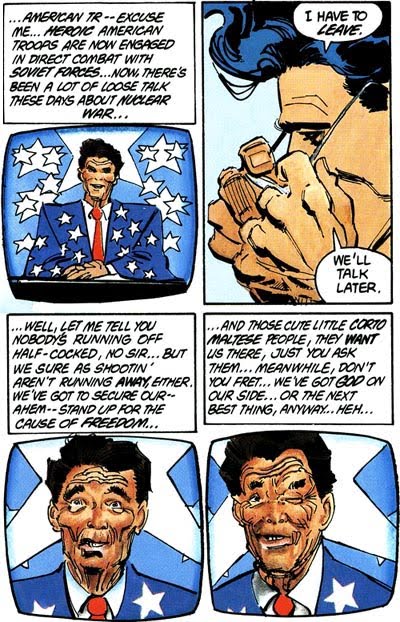
This series, which featured Reagan in a small but prominent role, is particularly interesting in contrast to (or conjunction with) his appearance in Legends, which was running concurrently with The Dark Knight Returns. In both books Reagan and Superman have a close working relationship, with Superman consulting with and deferring to the president in both series. The Dark Knight Returns, however, shows the potential dark side of such a relationship, as it portrays a Superman who has become less of a superhero and more of a government agent, taking orders from Reagan and going on covert missions to support the American power structure rather than the American people. As you might expect, the Reagan in this series is more of an ideological mummer, dressing up in star spangled suits and taking his "aw shucks" brand of senility to the American people on the airwaves to gain support for his military actions. It's a biting commentary on both Reagan's policies and American society in the 80's and has become, along with Captain America's Nixon, probably the most important use of a president in comics.

Somewhat less serious but almost as infamous is Reagan's appearance in Captain America #344. This took place during a long storyline where Captain America was ordered by the government to become an agent under their command (you may sense a bit of a theme here) and instead quit the role of Captain America in protest. The call-back to Englehart's famous Nixon storyline was both obvious and intentional, so it's only fitting that the story would involve the president. For most of the run (which lasted an impressive 19 issues), Reagan had just a bit part; it was shown more than once that Reagan was not aware of what his government commission was doing, with the implication that he probably didn't know much about what any other part of his administration was doing either. This had the double effect of making him seem both incompetent and sympathetic, because he clearly was on Cap's side but just didn't know anything was wrong to begin with, otherwise he would have stopped the whole mess (which eventually he does, in Captain America #350).

That's how Reagan was portrayed through most of the story. In issue #344, however, writer Mark Gruenwald took it out a whole new door as part of the culmination of his arc-within-an-arc about the Serpent Society. In this case, the evil nihilist Viper had seized control from the more pragmatic businessman (and founder of the Society) Sidewinder with the aim of toppling American government by poisoning the District of Columbia water supply. Cap and his friends are too late to stop this, and all of Washington is tainted by the supply. The poison doesn't kill people, though -- it turns them into mindless snake-men.

This led to the classic cover for #344, showing Steve Rogers (in his new identity as The Captain) standing in the Oval Office as a mutated, snake-man version of Ronald Reagan (shown in sinister silhouette) swoops in from the shadows with on goal in mind: to KILL! This great image from Ron Frenz is accompanied by the classic and pointed blurb "The Captain vs. the Deadliest Snake of All!"

In keeping with the tone of the series, the contents of this issue actually portray Reagan in a somewhat more benign fashion. With the populace of the city all turned into mindless snake people, Viper is able to waltz unmolested right into the Oval Office, where she stands around for a while, drinking in the sight of the president reduces to a nearly brainless animal state. Just as she is about to shoot him, however, The Captain shows up. Viper then gets to just about laugh herself hoarse as Cap is attacked by the mindless Reagan. Cap manages to fend him off without injuring him, Viper gets captured and the antidote is administered. Reagan, however, is still not made aware of the fact that it was Steve Rogers who saved the day, as by this time the government commission is in full cover-up mode and doing their best just to eliminate Cap and push it all under the table.

Overall, the Reagan era both returned presidents to their usual role in comics and also established a new standard going forward. While the days of Nixon appearing as a supervillain in every comic under the sun were gone, so too was the feeling that the president should be treated with kid gloves. Instead, a new, more nuanced and informed style of depicting the president emerged, one that allowed for commentary without needing to devolve into outright parody. But those times when it did, of course, invariably proved to be the most memorable.

Tomorrow: So how would seemingly liberal mainstream comic writers deal with a two-term Democrat in the White House? We'll find out tomorrow when we look at the 90's and the Bill Clinton era. See you then.


Bookmark and Share

Tuesday, September 29, 2009

In Defense of Fanboys

Fanboy. It's the dirtiest word in comics. Spend a little time on any comic book forum or website and you're bound to see it sooner or later, hurled as a dismissive insult by those who see themselves as above the fray. "Dude, you're taking things too seriously", these missives usually start, "stop being such a fanboy." The implications and definitions are clear: fanboys are deluded nerds who spend their time debating whether Superman could lift Thor's hammer, while the enlightened comic cognoscenti are worried about loftier ideals such as structure, tone, characterization. You know, the art form. In other words, stuff that faboys wouldn't understand.

Well, I'm here to say that not only should fanboys be respected, they should be both nurtured and courted. Because there's nothing as important to the future of comics as the fanboy.

In order to understand why the fanboy is so important to the future, though, we first need to understand how fanboys were regarded in the past. How did we get here? Once upon a time, strange is it may be to consider now, the fanboy stood at the pinnacle of the comic industry. Perhaps no fanboy has been as renowned or influential as Roy Thomas, who was emblematic of a whole movement of fanboys: the second generation of comic creators, those who grew up reading comics and wanting to write and draw comics from childhood. Thomas, in fact, got his start in comics thanks to being a fanboy; his work on the underground fanzine Alter-Ego became a focal point for the comic community and led to his eventual career at Marvel. Fanboys had taken over the industry.

And then something happened -- something called Watchmen. With a more cynical era came a more cynical view of comics; they were deconstructed and dismantled and while it led to some amazing and mature stories, it also led to some disillusionment for fans. It was no longer cool to just have fun reading superhero comics, because the emperor had no clothes. And this feeling -- that the hobby had been revealed as being, well, juvenile -- was only exacerbated by the exploitation of the fanbase by comic companies in the mid-90's that nearly led the to collapse of the entire industry. Gimmicks, holograms, variants and the speculation bubble was pushed along with shoddy art and half-assed storytelling in an attempt to turn a quick buck and the result was the mass exodus of fans who had been hit with this one-two-punch. The fanboy was gone and so was the money and the sales figures.

Which brings us to today and to a whole new generation of creators who have followed in the footsteps of Roy Thomas. Only, this new generation are the readers who grew up with Watchmen and lived through the deconstruction. Like scarred survivors of some pulp art holocaust, today's band of new fans and new creators live with a post-modern kind of post traumatic stress disorder. Everyone's versed in every aspect of the medium and the genre; they've read Understanding Comics and The Dark Knight Returns and the eat up Warren Ellis' blog posts and creator and reader alike foster a sort of hipster detachment. Characters and genre conventions are just pieces to be pushed around the game board, because we all know the rules now. We're in on the joke, and anyone who isn't in on the joke is the joke; we're smarter and cooler than they are because we care about the craft, we don't let ourselves get emotionally invested in kiddie stuff and they do.

In other words: they're just fanboys.

The mistake in this line of thinking is that it refuses to consider the idea that someone who has an emotional investment in a work can also apply critical thinking to it. You're either a fan or you're a critic, this line of reasoning states, and you can't be both at once. Well, that's just wrong. People who are fans of a series or character or story can also apply critical thinking to it. Being a good story and being an enjoyable story aren't necessarily the same thing. There are plenty of comics that I enjoy for personal reasons that I think objectively aren't good; and on the flip side, there are plenty of powerful, well made comics that I don't actually like. The idea that being a fan of a comic prevents you from applying objective criticism to it is patently absurd. Being a fan -- understanding how and why a character or a series has been successful in the past -- doesn't lead a reader to being less critical in their approach to reading comics, but rather to being more critical. Indeed, when Alter-Ego came out back in the 60's it wasn't remarkable because it about comics, but because it treated comics seriously and applied critical thinking to reviewing them. The wave of fanboys that became creators in the late 60's and early 70's were brought in by the big companies precisely because they had been doing this sort of critical thinking on the genre and the form. In other words, fanboys and objective criticism weren't mutually exclusive, because the fanboys were the critics.

Even if none of this were true, however, fanboys would be deserving of respect anyone for a simple reason: we need them. Comics need them. Comic book creators need them. Comic book publishers need them. Since the comic first debuted, fanboys have been the lifeblood of the business. The bond that forms between a fan and the characters and series that they love is one of the main things that keeps bringing people back, keeps filling stores and shows and keeps sales up to the point where the publishers can keep putting out new stories. It's a beautiful thing, really, this fandom. In a media savvy world, where everyone is aware of all the behind the scenes tricks, the fact that a reader can still allow themselves to be emotionally invested in the lives of a bunch of drawings is magic. Maybe that magic is gone for you and for me, but for those who still allow themselves this suspension of disbelief -- this willful innocence -- it's wonderful thing that we should praise, not mock. Because when the fanboy disappears, comics will disappear with them.

So think about this next time you call someone a fanboy, or the next time someone calls you a fanboy. And when they tell you that you're taking these comics too seriously, answer this: you can take yourself too seriously, but you can never be too serious about your comics.


Bookmark and Share