
Previously in the licensed worlds of Marvel Comics: Rom, Spaceknight evolved from a failed toy to an acclaimed centerpiece of Marvel continuity that became both the best team-up book ever and the primary force behind one of Marvel’s first mega events.
That was yesterday. Today we’re going to take a look at some of the other crossovers between Marvel superheroes and their licensed properties as we continue to
explore one of the stranger chapters in Marvel history, when toys, cartoon characters and superheroes all mingled together in one fantastic world.
[Note: this is not, by any means, a comprehensive list, it's just a cross-section of interesting examples. I'm not Sean McQuaid here, folks.]You may recall that during my discussion of
Rom yesterday, I described that series as being the only licensed book to be fully integrated into the Marvel Universe. However, that’s not technically true. There was one other long running licensed comic that was also firmly placed in Marvel continuity – it was just so small that I overlooked it. So let’s start off our crossover overview with a look at these tiny sci-fi heroes: the Micronauts.
The X-Men and the Micronauts 
During the late 70’s, it became clear to Marvel that X-Men was turning into a massive hit property, so they quickly did the logical thing: they pimped the sweet hell out of them. Within a period of five or six years, the X-Men managed to team up with other superheroes (see:
X-Men and Alpha Flight), other companies (see:
X-Men and the New Teen Titans), angry magazine mascots (see:
Obnoxio the Clown vs. The X-Men) , random civic potlucks (see:
X-Men at the State Fair of Texas) and, of course, homemade comics from young fans (see:
Kitty Pryde Meets Scott Harris Under the Bleachers #1-245). So from a marketing standpoint it only made sense for Marvel to throw the X-Men together with their hit toy property,
Micronauts.
The surprising thing here is that, unlike most of these team-ups, this one got its own series.
The X-Men and the Micronauts lasted four issues and told the tale of, well, microscopic astronauts appearing on Earth and the X-Men shrinking themselves down to tiny size. I mean, what else was it going to be about? We’ve already seen from the way
Rom storylines affected
Uncanny X-Men that Chris Claremont and
Micronauts writer Bill Mantlo are comfortable working together, but to be honest this series is just kind of meh. It also has the unfortunate side effect of reminding everyone that the Micronauts are, you know, subatomically tiny, which makes it harder for me personally to take uber villain Baron Karza very seriously.
One side note of interest: like
Rom’s supporting cast, Marvel owns the rights to characters it created during the duration of
Micronauts. Because of that, some Micronauts, like Bug (who is currently appearing in
Guardians of the Galaxy), are still part of the Marvel Universe, while those that were based on the toy line (like Acroyear) are not. Weird.
Fantastic Four and the Shogun Warriors
Hey, remember
Shogun Warriors? They were giant robot toys from Japan that were imported to America to try to capture some of our big capitalist toy market. In a lot of ways they were like prototypes for the Transformers – they sort of fit together and came apart to form giant robots, but not exactly, and like the Transformers, they turned to Marvel to try and help develop some sort of actual reasons for kids to buy this stuff (though the anime compilation show
Force Five did a much better job of this). Heck, there was even a
Shogun Warriors villain named Megatron back before Marvel got around to naming the main Transformers baddie the same thing.
Unfortunately, the comic was a giant flop, so Marvel decided to pull out the stops and bring in the Fantastic Four for issues #19-20 as a last ditch effort to jump start the series. Written by Doug Moench, the stories are sadly (but not surprisingly) lame as all hell, featuring a classic Hero Misunderstanding Battle between the FF and Combatra when the Shogun guys head to the Baxter Building to warn Reed Richards that their arch enemy, a glowing space cookie named the Primal One, was aiming to snuff him.
One interesting thing does take place here: Moench, as writer of the Fantastic Four, has an epilogue in
FF #226 that ties up loose ends for the series. So the three readers in the world that wondered what happened after
Shogun Warriors ended, now you know where to look.
Spider-man and the Transformers
Now, here’s a comic that will make continuity buffs explode in a ball of fire and blood. During the original 4-issue
Transformers mini-series (which was, of course, expanded to an ongoing title thanks to high sales), none other than the Amazing Spider-man showed up to help the Autobots out of a jam. Specifically, he was trying to help save that annoying Witwicky brat from, I dunno, getting drunk in a Walgreens and smashing his hand or something.
The point is, this crossover is treated as though it’s perfectly reasonable by everyone in the comic, even though it makes no sense for Spider-man to be in the Transformers world and even less sense for anything the Transformers are doing to be in the Marvel Universe (though, that would have been kind of awesome). I, however, have developed the perfect explanation for this, which I mentioned earlier this week. It goes like this: who cares! All that matters here is that Spider-man is hanging out with Optimus Prime; and when something completely unbelievable and awesome happens, asking how it could possibly be happening is beside the point and, I might add, a big turn off to the ladies (trust me). Just enjoy your, uh, web-slinging and leave the questions of continuity for lesser minds.
Spider-man and Red Sonja
Speaking of which.
Marvel Team-Up #79 and Chris Clarmeont bring us a tale of magic, mystery and, well, complete fanwanking. Basically, ancient evil wizard Kulan Gath gets brought to the present though an evil amulet. Who can stop his nefarious powers? Well, how about Mary Jane Watson?
As far as I can tell, the main purpose for this comic to exist is to get Mary Jane into that ridiculous chainmail bikini of Red Sonja’s. In other words, it’s a grand and noble purpose. Through magic, Red Sonja somehow inhabits Mary Jane’s body and she then teams up with Spider-man to take down Kulan Gath. The only down side to this plot line is that, thanks to Mephisto, this has probably been retconned to say that it was Aunt May taken over by Red Sonja instead.
The best part of this story is that, in typical Claremont fashion, Gath would go on to appear again in many other comics, including one of my favorite stories ever,
Uncanny X-Men #190-191 where he transforms Manhattan into Hyboria and faces off against swords and sorcery versions of the Avengers and X-Men. It might not be chainmail bikini awesome, but it’s pretty effing awesome!
The Human Fly and Ghost Rider Human Fly
is one of the odder entries on this list (which is saying something) due to the fact that the Human Fly wasn’t a toy or a pulp character: he was an actual guy. I don’t know exactly how the deal between the real Human Fly (a stuntman named Rick Rojatt) and Marvel worked, but basically in the comics he was exactly what he was in real life: a crazy stuntman who wore red longjohns and a Mexican wrestling mask.
The truly terrifying thing about his run-in with Ghost Rider in issue #2 is how much it must have scared young readers. After all, Marvel stressed that Human Fly was a real guy, and you could see Human Fly on TV and in the papers. So if he was meeting up with Ghost Rider, didn’t that mean that, ipso facto, Ghost Rider must also be a real person? A horrifying demon from hell itself who could show up at any moment and fix you with a penance stare to make yo pay for cheating on that phonics test?
I’m guessing this comic caused more eight-year-olds to crap themselves as they discovered the downside of logic than any other educational tool ever.
Thing and Doc Savage
Doc Savage is one of those old pulp characters that seems to have been infinitely more appealing to the writers at Marvel Comics than the readers. During the late 60’s and early 70’s there was a resurgence of interest in the pulp stories and heroes of the 1930’s. Marvel had already scored a huge success with its licensing of
Conan, so it probably made sense (to Roy Thomas, anyway) to give Doc Savage a try. Despite repeated efforts, though, including both a comic book and a large format black and white magazine, Doc never really caught on.
He did stick around long enough for this team-up with the Thing in
Marvel Two-in-One #21, however. This story is actually kind of cool. The Thing and Doc Savage end up on parallel investigations, each in their own era, dealing with two generations of people from the same family who are obsessed with some weird magic device. In the end, this device brings Doc and Thing together and merges the bad guys into one giant baddy named Black Sun, who they then defeat. No word on whether this was an inspiration for Soundgarden or not.
As a side note, DC now apparently has the rights to Doc Savage, as they recently announced they are doing a whole pulp universe inhabited by people without super powers like Doc Savage, the Shadow and the Spirit and… I dunno, whoever. I’m not sure they’re going to be any more successful than Marvel was trying to make Doc Savage popular today, but it sounds interesting, anyway.
Spider-man and King Kull
Yes, in
Marvel Team-Up #112, Spider-man teams up with King Kull! If you think this is awesome, well, congrats. That means you might be the only person in the universe who cares about King Kull. Yes, I get it, Robert E. Howard is great. Really, everything he ever did was genius. Hell, I eat Bran Mak Morn cereal for breakfast, okay? But I still don’t understand what audience was clamoring for this team-up.
The plot contrivance this time around is that Spider-man has been poisoned by… poison… and the only place to get the antidote from is the distant past. So Dr. Strange sends Spider-man’s astral form back in time to locate some antidote and, of course, he teams up with King Kull as part of it. I guess as far as plot devices go, this works as well as any. After all,
Marvel Team-Up’s usual plot involves Spidey randomly stumbling across something while he swings past on a nearby flagpole, so anything that isn’t complete coincidence is a step up. But really. King Kull?
Thor vs. Conan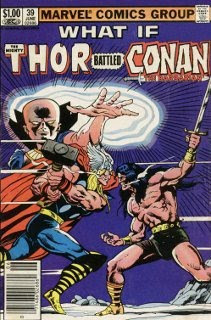
Finally, we have the granddaddy of Marvel licensed characters, Conan. When Marvel got the rights to Conan back in 1970, I’m guessing they had no idea the comic would turn into a mega-blockbuster that they would publish in multiple comics and magazines for decades to come. Interestingly, though, while they seemed to have no problem throwing the rest of their licensed properties into the MU, including (as we have seen) other Robert E. Howard characters like Red Sonja and King Kull, they seemed hesitant to do the same with Conan.
Instead, Conan’s out of continuity adventures were clearly labeled as such by appearing in the pages of
What If?, which brings us this classic tale: Thor vs. Conan. If I had seen this as a kid I would have been so excited I probably would have given birth to a Roc right in the comic store. In this tale, we learn what we probably all suspected anyway – Thor really likes being in Hyboria. He kind of likes it more than the rgular MU, actually, and he gets to do all sorts of rad MMO stuff including meeting Crom himself.
In fact, the only problem with this comic is that it’s so cool it makes you wish they just sent Thor back to hang out with Conan all the time instead of, you know, stranding him in Oklahoma. But as far as team-ups between Marvel superheroes and licensed properties, this story is right at the top of the heap.
Tomorrow: Wait, didn’t someone say something about Godzilla? Don’t worry, folks. They said it couldn’t be done! They said it shouldn’t be done! They said it wouldn’t be done! They even said it pudding be done, but that was probably trying a little too hard! Yes, tomorrow we take a look at the epic to end all epics: Godzilla vs. the Mighty Avengers! See you then.


 In a scenario becoming all too familiar to comics fans, Comic Book Resources is reporting that one of the greatest comic artists of all time has left us, as Frank Frazetta had died at the age of 82.
 Though Frazetta is best known for his magnificent fantasy paintings, dozens of which graced the covers of various novels over the years -- Frazetta's work was especially synonymous with Conan the Barbarian books -- he began as a rank and filer in during the Golden Age of comics. He quickly became a mainstay of the industry thanks to his detailed and lush linework, with his science fiction and fantasy art at EC garnering rave reviews during the mid 50's. A decade later, he began making the move to full time commercial painting, a decision that greatly expanded both his fan base and his wallet.


