


 Earlier this month I purchased a comic book that most people have never heard of, but which has had an important role in shaping both and pop culture and the development of art in the 20th and 21st century. It's impact on culture is arguably up there with Action #1 or Detective Comics #27. Yet while those other comics are worth hundreds of thousands of dollars, or more, I was able to pick up this 50 year old classic for just $4.50 thanks to its total -- and ironically apt -- obscurity.
 The comic in question? All-American Men of War #89.

All-American Men of War was, along with sister titles like Star Spangled War Stories, Our Fighting Forces and Our Army at War, one of DC's many classic war titles. These flourished during the 1950's and 60's but fell out of favor during the Vietnam War, with most of them ending by the early or mid 1970's; the final issue of All-American Men of War, #117, came out in 1966.
All-American Men of War #89, which hit stands with a cover date of February, 1962, is a typical issue of the series. It features three stories, each involving the air force during a different war -- World War I, World War II and the Korean War. The middle of these stories features the series' star at the time, Lt. Johnny Cloud, The Navajo Ace. The stories are interesting and competent but not particularly noteworthy.
There is one thing of note, though: In keeping with DC policy of the day, there are no story or art credits given. And it is this fact that helped create the anonymity which the issue and others like it has languished in to this day. Because, thanks to the seemingly anonymity of not just the artists but the art itself, nobody really batted an eye when that art was lifted whole, appropriated, repackaged and sold as what would become one of the most important art movements of the second half of the 20th century.
I'm talking, of course, about Roy Lichtenstein and the Pop Art movement. While just about nobody alive has ever even heard of All-American Men of War #89, Lichtenstein's works and aesthetic have been studied for decades in schools and displayed in art galleries. Other than hardcore comic book fans and art historians, though, few people realize that most of Lichtenstein's works, major and minor, were not the product of his imagination but were rather taken directly out of actual comic books -- swiped from other artists, blown up to canvas size and presented as original works.
Much of this, of course, has to do not only with the perception of comics as low art -- a perception that continues today -- but to the belief that the art in those comics was a disposable commodity, mass produced by some faceless worker turning out page after page in assembly line fashion. And in a way, that's true to a point; many of the artists themselves felt their art was just that, disposable, just a way to make a living while they pursued "real" art on the side.
But while Andy Warhol, king of Pop Art, was busy taking his inspiration from actual mass produced images, altering things like the Campbell's Soup can as commentary on modern culture, Lichtenstein's art was being taken from art designed and executed as art by other artists. And while the comics themselves may not have had credits listing those artists, the artists themselves were certainly aware of Lichtenstein's appropriations and the fact that Lichtenstein was becoming incredibly wealthy and gaining worldwide fame by selling copies of art they themselves had been paid often less than a couple hundred bucks for. And for which they would never receive any recognition.
All-American Men of War is one of the prime examples of this process due to the fact that Lichtenstein appropriated (some say outright stole) not one, but at least five different images for use in his work. The most famous of these comes from the aforementioned Lt. Johnny Cloud story, which is titled "The Star Jockey."
In this tale, Johnny Cloud relays a story from his childhood, when a shaman gave him a spirit vision that revealed to him a scene of his own future when he would fly fighter planes. In his vision, he sees a dogfight where the Nazis appeared to him as flaming stars in the sky. Later in the story, he shoots down an enemy fighter and it explodes in a brilliant fireball, causing Johnny to remember his earlier vision:

Art fans will probably recognize this right away as one of Lichtenstein's most famous paintings, and probably his most famous non-romance painting. Titled "Whaam!," this painting was completed in 1963:
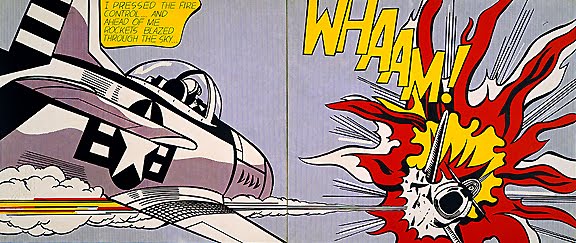
Just how much "Whaam!" is worth today is hard to say, as the Tate Museum purchased it in 1966. But we can get a good sense based on sales of other Lichtenstein paintings that have sold recently, such as "I Can See the Whole Room! ... and There's Nobody in It!," which sold last November at a Christie's auction for $45 million.
The original art that was used to create "Whaam!" was done by an artist named Irv Novick, who as I mentioned was not credited in the actual comic book. Did this fact play a role in Lichtenstein's apparent belief that it was unnecessary to give credit to Novick?
An interesting sidebar comes from an anecdote whose origin I'm afraid I no longer have attribution for. It seems, however, that when Lichtenstein became a huge star in art world during the early and mid 1960's, thanks in large part to early works such as "Whaam!," a number of the artists he swiped from were quite upset. Lichtenstein ended up meeting a large group of them and explained that he had never expected his stuff to take off and he was just as surprised as they were; he was just a starving artist who got lucky. Charmed, the other artists decided not to press the issue.
On the other hand, we also have the story of Russ Heath, a comic book legend who (unlike Novick) is still alive. Recently Heath conducted some interviews that coincided with a drive to try and raise money to cover his escalating health care costs because, as an artist, he had no pension or health coverage to speak of. In the interview, Heath explained that on more than one occasion he invited Lichtenstein to dinner, but was turned down on each occasion. For me, it paints (perhaps unintentionally) a picture of an artist who doesn't want to acknowledge where his fame and fortune truly come from. Was he embarrassed by the fact that he was making millions of dollars while the artists he appropriated works from remained unknown and sometimes living in poverty? Was he covering it up in order to preserve his own image?
Heath, as it happens, is another artist who contributed to All-American Men of War #89. His story is the third in the issue; set during the Korean War, he depicts a dogfight between a young pilot desperate to become an ace and his communist attackers. At one point the pilot tries a desperate maneuver and drops a bomb on a plane cutting beneath him. The bomb blows up the plane, as shown in this scan from the great site Deconstructing Lichtenstein, which chronicles Lichtenstein's extensive swiping:http://www.blogger.com/img/blank.gif

This image was later used to create Lichtenstein's painting "Blam!"

And that's just the tip of the iceberg for Heath's contributions to Lichtenstein's ascent in the art world. Another panel of Heath's from the same story was used on the cover of All-American men of War #89, re-intepreted by cover artist Jerry Grandenetti -- which makes Lichtenstein's work "Jet Pilot" (inset) a copy of a copy:

And two more Heath panels from the same story (!) were also used by Lichtenstein, for "Brattata" and "Okay, Hot Shot," the images of which can be seen here and here.
The artistic merits of Lichtenstein's work as compared to the originals can be debated. Many comic fans feel that the original art is better executed and better drawn than Lichtenstein's copies, but this seems partially intentional to me, as Lichtenstein flattened out the images as part of his commentary on pop art. Likewise, his brighter colors and mostly his greatly expanded scale create a far different visceral impression than the small images found in the comic itself.
A more pressing question for me and many others, though, isn't whether Lichtenstein the artist has merit on his own rights but rather whether Lichtenstein the man did the right thing. And though I only know what I have read second hand, to me he failed epically in this. While he was making money hand over fist and earning accolades from art critics and historians around the globe, the artists whose works he was feeding off of remained toiling away in obscurity. That obscurity and their financial burden could have been greatly changed merely by Lichtenstein acknowledging their contributions to his work. Yet he did not, even while continuing to turn out image after image knowlingly and purposely pilfered from the artists of the comic book world.
Simply by providing proper credit, Lichtenstein could have given artists like Novick and Heath a whole new world of opportunity by highlighting their work on a world stage. The money they could have made just from commissions alone would have likely prevented the spectacle of Heath, in his mid-80's, having to search for work online to pay his medical bills. Yet Lichtenstein kept the credit and the spoils for himself.
And maybe that's the true importance of All-American Men of War #89. Because beyond the fact that it directly led to an entire art movement, it also now stands as an object lesson and warning for any artist in any field. Not to mention a condemnation, in my eyes, of the art world. Can you imagine what it must have been like for these artists to watch as someone copied their work and was hailed as a genius while their own art was still derided as cheap junk for kids? For me, it's a reminder to judge things for yourself, for what they are; and to give credit to those who deserve it, not those who ask for it.
So there's the story of All-American Men of War #89, the most important comic book that you've never heard of, a comic that in its own way influenced culture as much as Action #1 or Detective Comics #27 but which, unlike those, commands no premium on the back issue market and is sought after by no one other than the hardest of hardcore war comic fanatics. And if it seems both ironic and somehow fitting that All-American Men of War #89 should be as forgotten and overlooked as the artists whose works fill its pages, well, it is.
Fitting, but hardly fair.
 (note: It should be mentioned that Lichtenstein's swiping -- what some comics fans would call outright thievery by http://www.blogger.com/img/blank.gifan art world con man -- is hardly limited to his war paintings or All-American Men of War #89. Indeed, nearly every single one of his works was taken directly from another artist's work, usually at DC, including his famous romance paintings. The Deconstructing Lichtenstein site has carefully uncovered dozens and dozens of instances both in the war and romance comics as well as from other sources. Oh, and that painting "I Can See the Whole Room! ... and There's Nobody in It!" that sold for $45 million last year? It was a straight up copy of a panel done by artist William Overgard for the comic strip Steve Roper, as seen in this inset, again by David Barsalou and his Deconstructing Lichtenstein website.)


