Game Review: Diablo 3

Diablo 3 is out. But is it a game? Or is it the most brilliant money making scam in internet history?

Movie Review: The Avengers

Okay, okay, I posted my Avengers review. Get off my back already, geez.

The Most Important Comic Book You've Never Heard Of

Action Comics #1. Detective Comics #27. Why is All-American Men of War #89 as important as these great comics -- and why have you never heard of it?.

Tales From the Vault: Lois Lane #93

If you thought Superman was a total tool before, you ain't seen nothing yet.

Mass Effect 3: The Official Review

Mass Effect 3 isn't the end of the world, it just portrays it.

Showing posts with label Fantastic Four. Show all posts

Thursday, April 15, 2010

Top 5 Superhero Weddings

Welcome back to our sporadic look at comic book weddings. Previously we gazed in slack jawed wonder at a gallery of some of the weirdest wedding covers ever. Today we're going to turn to a staple of the industry: superhero weddings. And, naturally, our list of the top 5 weddings consists entirely of Marvel events.

Now, I know what you're thinking: man, that FFF thing really went to your head. Well, no. I mean yes, but not in this case. Rather, this is simple acknowledgment that the superhero wedding as we know it was invented by Marvel and pretty much every superhero wedding of the last fifty years is a copy of Marvel's inimitable style. So though there are many high profile and no doubt interesting superhero weddings over at DC and Image and wherever else, we're going to keep it real by looking solely at Marvel, a decision helped by the fact that the top four superhero weddings of all time are undoubtedly from Marvel anyway, meaning we're really just debating the number five spot. So stop whining.

And where does that leave number five? Well, it was a bit of a toss-up between a number of other worthy events (including, for instance, the wedding of Peter Parker and Mary Jane Watson in Amazing Spider-man Annual #21 and the union of Scott Summers and Jean Grey in X-Men #30) but after careful consideration I decided instead to go with a bit of a dark horse candidate (though not from Dark Horse Comics, of course)...
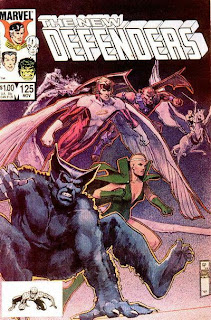


5) Hellcat and Son of Satan

Coming at you straight form the pages of New Defenders #125, it's the wedding all of the underworld has been waiting for, Hellcat and Son of Satan. This rather bizarre issue gets the nod for a couple reasons. Firstly, it contains the pre-requisite attack by supervillains, in this case the uber lame Mutant Force (which at least also included Hellcat's ex-husband Mad Dog). But it also signaled the end of the original Defenders team and concept thanks to the dues ex machina device of some cosmic dudes telling them they had to disband forever or else the world would be destroyed. Being the heroes they are, they were like, "sounds reasonable," and all quit (later to find out, of course, that this was just a really obvious trick). And as a result, the "New" Defenders formed, which were just like the old defenders only with more X-Men involved. All of this taking place in the middle of a supernatural wedding being narrated by a pink leprechaun for essentially no reason. New Defenders, same as the old Defenders.


4) Quicksilver and Crystal

Let's face it: nobody in comics does weddings quite like the Avengers and the Fantastic Four. So it's only fitting that we highlight the wedding of Crystal and Quicksilver, which took place in a crossover between Avengers #127 and Fantastic Four #150. Of course, the proceedings were interrupted by a giant-sized Ultron-7, inhabiting the body of the Inhumans android Omega. And with a union blessed by an inhuman killing machine, it's no surprise that the two later divorced after Crystal had an affair with a New Jersey real estate agent. Yes, Pietro was just that boring.


3) Vision and Scarlet Witch

Perhaps the weirdest wedding ceremony of all time (no pun intended) took place in Giant-Size Avengers #4 when the synthezoid Vision was married to the mutant Scarlet Witch by the ageless lord of limbo, the time traveler Immortus. And they weren't even the weird part. That goes to the fact that this was a double wedding, with Mantis (aka the Celestial Madonna) tying the knot with a sentient tree that had been animated with the soul of her dead lover Swordsman. We're guessing the reception was a real party.


2) Hank and Jan Pym

Maybe the greatest superhero wedding cover of all time, Avengers #60 features the union between Wasp and Hank Pym, who was at this point in his Yellowjacket identity. That's because he had suffered a complete nervous breakdown that led to the formation of a split personality; recognizing her boyfriend Hank Pym under the new mask, the Wasp seized her chance and finally wrung a wedding proposal out of her deranged lover. By the time he returned to his senses, it was too late: the Avengers had already defeated the marauding Circus of Crime at the reception and he was a married man. Epilogue: marrying someone when they are temporarily insane is not the foundation of a successful marriage.


1) Mr. Fantastic and The Invisible Girl

Could there ever be any doubt what the top pick would be? Unquestionably the most important wedding in comics history, the ceremony between Mr. Fantastic and the Invisible Girl in Fantastic Four Annual #3 set the standard for all superhero weddings that would follow. Not only was it a landmark event in Marvel history, it also established the trope of villains attacking superhero weddings, in this case resulting in one of the great battle sequences in comics history as an entire army of supervillains assaults the wedding, only to be fought off by the combined might of every Marvel superhero in existence, all of whom had gathered to celebrate the wedding. Add in a cameo from Stan and Jack themselves and you have an all-time classic -- and our number one superhero wedding of all time.


Bookmark and Share

Wednesday, November 18, 2009

Presidents in Comics: The Nixon Effect

Who is the greatest supervillain of them all? Is it Lex Luthor? The Joker? Dr. Doom? The Red Skull? Magneto? The Headmen? The Tetrarchs of Entropy? Turner D. Century? The debate has raged on for decades, but above all of these fictional villains towers an all too real arch-villain on a scale unprecedented in comics: President Richard M. Nixon.

Yes, Richard Nixon, who would, of course, go on to resign in disgrace after Watergate, became a target for comic book writers almost immediately upon his ascension to the presidency. Though the bulk of the attacks didn't get into full force until the Watergate scandal broke, even before that it was clear that the respectful kid gloves usually reserved for treatment of presidents in comics had been set aside. Part of this is due to the changing political climate in the nation, and part of it was due to a more direct source: a changing of the guard in the ranks of comics creators, especially at Marvel. Out were the older generation of creators who had grown up with the industry, right from its World War II roots, and in was a new generation of post-war creators who had grown up on both comics and distrust of the government. This new generation of writers and artists, including those with noted political stances such as Gerber and Englehart, were quick to seize on Nixon as a foil -- a decision that forever altered the way presidents were depicted in comics.

Things didn't start too badly for the president, of course. One of his earlier appearances, in 1970's Fantastic Four #103, was of the more traditional variety, with Nixon calling upon the FF to save New York from an Atlantean invasion (though even here, Stan did manage to slip in a little snipe about the direction of the Vietnam War). And this sort of thing also took place over in staid DC titles like World's Finest, where Nixon appeared in the usual presidential cameo role.

The tide was turning, though, something that can be seen in comics like Incredible Hulk #139. As we saw yesterday, a few years earlier Nixon's predecessor, Lyndon Johnson, had also dealt with the Hulk in Tales to Astonish #88, seeing right to the heart of the tragic beast and giving Banner a full pardon. Not so much with Nixon; in #139, Nixon prevaricates while discussing options with General Ross and finally decides to delegate authority to his hand-picked liaison Spiro Agnew. That, as history has shown, was usually not a good idea and the predictable ensued.

Thus the long-standing principle of always having the president be an honorable, upstanding guest-star was slowly being chipped away at. Gone were the days of "If I can't trust the president of the United States, who can I trust?" and in were the days of sidelong, if still not too pointed, political commentary. In Fantastic Four #123, for example, Nixon (who even lands a guest spot on the cover) debates whether or not to turn matters over to the Fantastic Four, worrying that he "has an election coming up". And even more subtly, Jack Kirby drew a small bit of Republican ire when he supposedly modeled one of the kids in Jimmy Olsen's Newsboy Legion strip on Tricky Dick. Hell, even Richie Rich got involved, using Nixon as a lab assistant named, for no apparent reason, after the band Uriah Heep.

But then Watergate hit and all bets were off. Jabs and snide remarks weren't enough anymore; with righteous indignation, the comic world began really venting its anger on Nixon. DC, for its part, was still fairly mild, simply going with items like a caricature of Nixon on the cover of From Beyond the Unknown #17 where aliens decide that Earth must be a myth because any planet that would have Richard Nixon as its leader is "scientifically impossible!"

Marvel, though, was pulling no punches. Steve Gerber, who would go on to create the politically savvy comic icon Howard the Duck, immediately cast Nixon as the villain in the infamously titled Giant-Size Man-Thing #1. In this story, Nixon appears as the leader of a cult of entropy; wearing a hood and spouting nihilist slogans, Nixon (who is known among his disciples as Yagzan) tries to bring about the end of, well, whatever is supposed to end; that's how entropy works I guess. Luckily Man-Thing is around to save the world, even if real-life America wasn't so lucky.

But the most famous Nixon story of all time, and one of the most infamous storylines in Marvel history, has to be the Secret Empire story that ran from Captain America #169-176. In events specifically designed to parallel Watergate, Captain America uncovers a vast conspiracy by a shadowy organization called the Secret Empire. Following the paper trail, he discovers that this plot to covertly control America leads right into the White House itself and in the #175 he is shocked to find that the leader of the Secret Empire is none other than President Richard Nixon.

Confronted with evidence of his misdeeds, and faced with America's fighting legend himself, Captain America, Nixon does the only thing that he can do: he commits suicide in front of the shocked hero. The entire episode leads to Cap questioning both America and his role in the nation and results in Steve Rogers deciding to quit as Captain America because he no longer believes in the government.

Eventually, of course, he decides that he does not represent the American government, but instead the American dream, something that is stronger than any one politician, no matter how corrupt. This was a defining storyline in the history of the character, as it crafted a specific new role for Cap that he has maintained to this day, showing how the character can still be viable in a nation that no longer trusts its own government. Because of that, it remains perhaps the quintessential Captain America storyline of all time, which means that in the end, Nixon's presidency ended up getting at least one thing right.

Finally, I would be remiss if I didn't also briefly mention the other most famous Nixon story in comics, which was printed over a decade after the president left office: Watchmen. Everything in the story is informed by the Nixon years, as it takes place in a world where Nixon not only never stepped down, but was in fact re-elected several times, becomes a de facto president for life. Alan Moore and partner Dave Gibbons were commenting on the Reagan era as much as on Nixon, but the images of Nixon calmly discussing how much of the nation was an acceptable loss in case of a nuclear strike is still among the most indelible graphics from that most famous of comics.


Once that cat was out of the bag, of course, it was impossible to put back in. Nixon had changed the way presidents were treated in comics; instead of across-the-board respect, individual presidents were now treated as just that: individuals, to be lauded or ridiculed based on both their actions and the political leanings of the creative team depicting them.

Tomorrow: We'll be looking at the biggest target this side of Nixon, Ronald Reagan, as we look at how the new rules established in the 70's paved the way for one lampoon after another in the 80's. Featuring, of course, the famous "Reagan literally turns into a giant snake" story. Be there!


Bookmark and Share

Sunday, September 27, 2009

Seven Questions with TOM BREVOORT

Today, the Vault is excited to present seven questions with Marvel editor Tom Brevoort. For those of you who were hoping for more from the small press and self-published creators we've been talking to in Voices from Artists Alley, don't worry; there's another convention coming up next month, so you can expect to see more interviews soon. But today, we're going to head back to the big guns: over the last twenty years, Tom Brevoort has overseen a number of acclaimed and popular projects including current series such as New Avengers, Captain America and Fantastic Four as well as some of the industry's biggest events, such as Civil War and Secret Invasion. Tom was gracious enough to spend his valuable time answering some of the longest questions ever composed in interview history, so won't you do him a solid and take a couple minutes to read his thoughtful answers?


1. While you are well known as the editor of such bestselling titles as New Avengers, you also oversee a number of somewhat lower profile books as well. What can you tell us about the projects that you have coming out soon, and which books should discerning comics readers keep an eye out for that they otherwise might not be aware of?

This is such a broad question that it's difficult to know where to start, and it's hazardous in that somebody's sure to take offense if I leave their project out. But let me just work my way down the list. As I have for the past decade, I'm continuing to edit the AVENGERS family of titles, NEW, MIGHTY and DARK, as well as CAPTAIN AMERICA (currently on hiatus while REBORN plays out), SECRET WARRIORS and FANTASTIC FOUR (on which Jonathan Hickman and Dale Eaglesham just began an excellent run) and a bevy of limited series, one-shots and side projects. But if I had to aim people at a few special projects, the three I'd want to bring up would be 1) THE MARVELS PROJECT, in which the award-winning creative team of CAPTAIN AMERICA, Ed Brubaker and Steve Epting, tell the undisclosed origin of super heroes in the Marvel Universe. 2) NOMAD, GIRL WITHOUT A WORLD, wherein Sean McKeever combines his skill at writing teen drama with super heroics set firmly within the landscape of the main CAPTAIN AMERICA series, with artwork by David Baldeon, and 3) STRANGE, Mark Waid and Emma Rios' reinvention of Stephen Strange, no longer the Sorcerer Supreme and on a journey of discovery as a result. All three are high-quality projects, each with a very specific sensibility and a unique flavor. I really dig them.


2. There seem to be as many different styles of editing as there are editors in comics, with some taking a hands on role in shaping the direction of the books and characters while others act more as facilitators for whatever the creative team feels like doing. How do you define your own role as editor?

I think there are different editing styles even within the hands of a particular editor, depending upon the needs of the project and the creative team. Every interaction I have with various creators is different, and so I don't have a single way that I edit comics. But my log-line description of the role of the editor (at least when it comes to editors who work on company-owned properties such as Marvel and DC possess) is that he's a combination of the coach and the manager of a ball club. The editor doesn't play in the game, but he gets to select who does. He can switch out a substitute, or call in a pinch hitter as needed. He can call for a specific play. And it's his job to make sure that the team is at the ballpark on game day, ready to play. The editor is also not the star. While in the day-to-day course of doing the job any given editor may throw off story ideas or ways of restructuring or improving a particular tale that others then get to make hay out of, the editor really belongs backstage, directing the action from there. The creators do the work, so they deserve and get the credit. Editors get the blame. That's not a condemnation of the system in any way, merely a statement of fact--and one that a would-be editor needs to embrace before he's truly ready to play in the big leagues.


3. Over the last year you've been involved in an ongoing project on your blog where you are trying to trade up from some random back issues to a copy of Fantastic Four #1. For me, it harkened back to the old days of collecting when fans would write each other through lettercolumns and swap back issues. What brought this about and do you have anything similar planned for the future - say, perhaps a run at Captain America Comics #1?

As you probably know by now, my Trading Experiment finished up earlier this month, when I did in fact trade for a copy of FANTASTIC FOUR #1, which will be auctioned off to benefit the Hero Initiative. We're talking now about possible ideas for follow-ups, though I don't think trying to go back as far as CAPTAIN AMERICA COMICS #1 is very realistic--for all that it's rare and valuable, there are a lot of copies of FANTASTIC FOUR #1 out there, far more than there are copies of books like CAP #1. You can go to any comic book convention and see dozens of FF #1s floating around. Plus, I wouldn't want to simply repeat myself. This whole experiment was inspired by the works and the writings of Danny Wallace and Dave Gorman. First together then separately, they pioneered a specific kind of genre--the "real world adventure", wherein they would take on a quest or a mission of some kind, and then recount the adventures they experienced while attempting to fulfill their mandate. Danny's slightly better known in the States as the guy whose story the film "Yes Man' was based on. So I was rereading their collection of works, spurred by their respective new releases Friends Like Me and America Unchained, and thinking about something similar that I could do (without all of the traveling and expenses and upheaval of lifestyle that they regularly engender) and that's where I hit upon the notion of the Trading Experiment. One of the other elements that runs through Dave and Danny's books is a feeling of the overall generosity of spirit of people, and that was certainly borne out by my experiences with the Tradees, who typically offered more than they were getting, and in many cases donated rare comics without asking for anything in return, just wanting to give to a good cause. So it was a lot of fun, and hopefully we can come up with a worthy successor concept down the line.


4. One of the more interesting things you've been doing on your blog is posting some internal memos and directives from Marvel's past. One of these that caught my eye included a release schedule that had a number of Avengers issues, such as #504, that were never produced due to Disassembled and the launch of New Avengers, which suggested that the decision to do those projects came about pretty late in the publishing process. I'm wondering just what the genesis of that decision was - did you or other members of the editorial team come up with the idea for New Avengers, was it the result of a pitch from Brian Michael Bendis, or did it come about through some other fashion?

NEW AVENGERS came about at one of our creative retreats, where the senior editorial staff gets together with most of our key writers to chart out the course of our publishing plan and our stories for the next year or so. At this particular retreat, a lot of time was spent in trying to drill down to the essences of what each series was meant to be about, in an attempt to either pull them back on-message a bit more, or alternately finding new and interesting avenues to take them in. And as we discussed AVENGERS, Mark Millar said that he didn't understand why the Avengers were so often all these second string characters that he had never heard of. What made the idea of the Avengers cool to him was the notion that it would be the book with all of the biggest and best characters in it. After some discussion, we broke for dinner, where Mark and Brian discussed these ideas a bit further, and by the time everybody came back in the next day, Brian had put together the outline of his pitch to take over the series, what eventually became NEW AVENGERS. So the story and the approach of AVENGERS: DISASSEMBLED and NEW AVENGERS was Brian's, but the instigator of the concept was Mark and everybody else who was in on those discussions at the time.


5. As a reader of New Avengers, one thing that frustrated me was the disbanding of the New Avengers team in Civil War, as so much of the series up to that point seemed like setup (for instance, the introduction of new members like Sentry and Ronin, Spider-woman being a double agent, the subplot with the new Black Widow and SHIELD, etc.); having the team disband before any of that was addressed led me to question the purpose of those stories. I'm wondering in general, how do editorial and creative teams handle interference from mega events, and specifically how much of what Bendis originally had planned for New Avengers ended up being used in New Avengers or Mighty Avengers and how much of it had to be scrapped?

Interference from mega-events makes the assumption that people are being coerced into participating in these stories, which really isn't the case. While it's true that CIVIL WAR changed the trajectory of some of the stories that Brian was developing (including the groundwork for SECRET INVASION that he was laying), the conception and development of CIVIL WAR came out of another of those creative retreats, and Brian was there in the room to discuss and debate the storyline, and was completely on board with participating. He did some of his strongest work on the CIVIL WAR issues, I thought, particularly the Luke Cage issue and the CONFESSION epilogue issue. Of course, there are degrees of involvement--if you're writing Captain America and Captain America is going to play a major role in an upcoming event storyline, then it's going to impact upon you in some way. But that's all part of the deal when you're playing in the shared universe sandbox of the Marvel Universe.


6. One of the main events that spun out of New Avengers was Secret Invasion. You recently posted on your blog an original draft from Bendis for this story and in it the big casualty was Hercules rather than Wasp (who died in the published version of Secret Invasion). When it comes to planning these events, how are these kinds of decisions made? Was this change a result of Greg Pak's desire to use Hercules, or Dan Slott's interest in exploring the effect of Jan's death on Hank Pym? Or is it the other way around, where those projects came about because this change was made? Or some combination of the two?

It's different in each of the cases you cite. Hercules dying at the end of SECRET INVASION was just a notion that Brian was toying with at the outset of outlining his story, one that he didn't get very deep into thinking about, as we at that point were beginning to plan to launch INCREDIBLE HERCULES out of WORLD WAR HULK, and that sidelined his thinking. But it was Brian who decided to make the Wasp the final casualty, building off of seeds he'd left himself in early issues of MIGHTY AVENGERS, and it was Dan, coming onto MIGHTY as Brian cycled off, who chose to pick up that baton and run with it in terms of exploring how her demise would affect Hank. Ideally, this is how our stories and creators should synergize, with each one finding inspiration and building on the work of the others.


7. Lastly, what's one specific storytelling technique your creators use that you could share with new creators to help them hone their craft?

There are couple of concepts and ways of thinking that came to the fore during the craziness of the Bill Jemas-era--Bill could get overly dogmatic about his thinking, but he made a number of really good, really important points with regard to telling stories that can be embraced by a broad audience, which should be the goal of any storyteller. Start at start--tell your story from the beginning, and take the time to introduce your characters and make me feel for them. Keep your storytelling straightforward--while it seems clever to try to employ byzantine storytelling structures, often a new writer's reach will exceed his grasp, and they'll often try to disguise an inability to generate empathy or reader involvement with their ideas by the use of complicated narrative tricks. There's nothing wrong with being straightforward and clear. Don't play exclusively to the cheap seats--while we love our hardcore longtime audience of readers (of which I am one), if you're creating material aimed at them exclusively, if your plot turns on being conversant with an earlier story published two decades before or you don't identify or characterize the shocking mystery villain you've brought back out of the shadows on the last page, you're talking past most of your potential audience. Finally, have something to say--understand the metaphoric content of your stories and make them about something that relates to your readers' lives. This needn't be a straightforward one-to-one affair, but the best, most successful, more memorable stories are about something more significant that one super hero pounding another, and speak to the common experiences, fears, dreams and desires that everyone share.


Bookmark and Share

Friday, August 28, 2009

Tales From the Vault: GODZILLA #24

On our final day of our week-long exploration of the mad marriage between Marvel comics and their various licensed properties, we look at the second part of the battle to end all battles: Godzilla vs. the Mighty Avengers!


Details: Once again, this July, 1979 offering is brought to you by the dream team of Doug Moench and Herb Trimpe, with Al Milgrom on editor duty. I should also mention that the inking is done by Dan Green; if I don’t, Bob Almond will probably karate chop me in the face. Plus, it’s particularly important here because I’m not sure any major comic artist has ever been as influenced for good or bad by his inker as Herb Trimpe. I don’t know if this means his pencils are just bland and forgettable as some people say or if it means he’s just really solid, but the quality of his work varies wildly depending on who is inking him. Green is one of the good ones, and as a result this issue looks pretty good.

Synopsis: When last we saw Godzilla, Yellowjacket and Wasp had thoroughly cleaned out his inner ear, which tickled so much that the giant dinosaur toppled into the Hudson River. Now he’s back on his feet and ready to resume his major throwdown with the Fantastic Four, the Avengers and SHIELD. But mostly with the Avengers.

Or, rather, he’s ready to ignore all of them and knock over the Empire State building instead, because, you know. Why not, really? This is something that our heroes just cannot allow, so the Avengers, the FF and SHIELD all rush into action. All except Thor, who instead stands on a rooftop and tries to figure out some kind of strategy to beat Godzilla. Man, this would be a good time to have some brilliant tactician on your team like Captain America, huh? Too bad he’s playing Pong with Wanda back on monitor duty. Good job, Thor!

(Side note: as Godzilla walks towards the Empire State Building, he passes an office where a nice scene of sexual harassment is taking place. Ah, the swinging 70’s! Stranger, for some reason Moench decided to name the sleazy boss Jarvis. Out of the billions of names available, why would you go with one of the handful that your audience is guaranteed to identify with one of your characters? I think “Mr. Smith” might have worked a little better here.)

While Thor hurts himself trying to think, The Fantastic Four decide to actually do something, so Reed Richards comes up with his own brilliant plan: pigpile on Godzilla! This accomplishes about what you would expect, namely widespread destruction and loss of human life. Luckily, while the FF is totally bungling everything, the Avengers are around to save the people of the city, which they do in a nice segment where Thor stops some falling debris and Iron Man saves some people from a burning building. It’s always cool to see superheroes actually helping people instead of just fighting villains.

However, that’s not going to keep the Empire State Building from falling over, so it’s time for plan B. Ini a pretty awesome display of might, just as Godzilla is about to knock the building over, Thor swoops in and props it up. Thor and Godzilla then both shove on the building from opposite sides, neither able to budge the other, until finally the building itself begins to shatter under the pressure. Damn right!


So now, as Wasp says, it’s desperation time. There’s only one thing left to do: a bigger pigpile on Godzilla! This time the Avengers and SHIELD join the FF in an “all-out blitz”, leading to a thoroughly sweet double splash of Godzilla taking them all on right in the heart of Manhattan.

Unfortunately, this moment of pure comic bliss is interrupted by the whiny little snot Rob “lizard lover” Takiguchi. Freeing himself from his SHIELD captors by kicking them in the shins – man, why didn’t Hydra ever think of that? – Rob rushes out onto the Helicarrier’s… uh, helipad… and begins weeping like Kate Gosselin. While all the heroes stand around, frozen by the tenderness of this moment, Rob implores Godzilla to stop fighting and just sort of walk over there into the ocean.

Moved by the kid’s heartfelt plea – or, more likely, eager to get away from this little whinebag as soon as possible, Godzilla does just that: he turns and walks right into the ocean, vanishing forever. And, wouldn’t you know it, just as he does so, Spider-man finally shows up, just in time to take that photo J. Jonah Jameson has been screaming about for two issues. Interestingly, we never see this picture, but context clues suggest that the photo he took is actually the cover of this issue. So for everyone who wondered what Peter Parker’s award winning photography looks like, wonder no more: it looks like it was drawn by Herb Trimpe.

And that’s… THE END!

Extras: Interestingly, there’s no mention in the letter column -- or as far as I can tell anywhere else -- that this is the last issue of the series. It’s implied a few places, but not actually stated outright.

Also of interest is the Hostess Fruit Pies advertisement in this issue. It features Thing fighting the robot Torgo, a.k.a the Ultimate Weapon. You may recall Torgo from a number of storylines in Fantastic Four, most notably the Slave Pits of Kral epic in Fantastic Four #91-93, which in some ways was a precursor to the popular Planet Hulk storyline from a few years ago. It’s a bit unusual for a Hostess ad to feature such a well known villain instead of some made up nobody. All you Torgo completists, get out your checklists!

My Grades: I really enjoyed this issue, though not quite as much as the last, due mainly to the sappy ending that you could see coming from another universe. I’ve still got to give it a B+ though, with an A+ for the great (though brief) Thor/Godzilla tussle.


Bookmark and Share

Thursday, August 27, 2009

Tales From the Vault: GODZILLA #23

Next up in our week long exploration of Marvel's licensed properties is a review of Godzilla #23, where Godzilla comes face to face with... the Mighty Avengers! Oh, yeah.

Details: This instant classic comes to us from the halcyon days of June, 1979. The unbeatable creative team behind it? None other than the legendary duo of Doug Moench and Herb Trimpe. Now, I know what you’re thinking: where did I leave that bottle of sleeping pills? But don’t worry, we’ll get through this together. Plus, this is actually during Trimpe’s strongest Kirbyesque era, so it’s pretty decent, and Moench has his moments as well. And, hey, it could be worse: Al Milgrom is the editor and he could have assigned himself pencils. Anyway, let’s get to it.

Synopsis: We jump right into the action (apparently continued from Godzilla #22) to find Godzilla rampaging through Manhattan. The only people who can stop him? The Mighty Ave… wait, it’s the Fantastic Four. Hmm.

Okay, whatever. Yes, the Fantastic Four – and by “Fantastic Four” I mean Reed Richards and Johnny Storm, because the others aren’t anywhere to be seen – are duking it out with Godzilla while high overhead the SHIELD Helicarrier watches the action. And by “high overhead” I mean, they’re floating about 50 feet off the ground. Maybe I should choose my words more carefully from now on.

Anyway, for whatever reason, Godzilla has become enthralled with the Helicarrier and has decided to bash it to pieces (my guess? He’s a skrull). I should also note here that this version of the Helicarrier is basically a big floating Lego; it’s little more than a big flying brick. I imagine this was much easier to draw than the original version, but it also looks like total crap compared to the awesome design the Helicarrier used to have, so I’m a bit put out by this.

Reed uses his gigantic brain to come up with an infallible solution to this problem: have the Helicarrier lead Godzilla to the river and then, I dunno… hope he’s made of salt. While Dum Dum Dugan complies with the order (no sign of Nick Fury anywhere – they probably realized Fury could have beat Godzilla with one hand tied behind his back so they had to leave him out of the story), Reed rushes off to find Ben and Sue while the Human Torch goes to summon the Avengers. That’s right, you pussies, go bring in the real heroes.

While they do this, Godzilla continues on his rampage and we meet some weepy little snot of a kid (Rob Takiguchi) who apparently loves Godzilla or something. You know the type – this kid is almost certain to save the day by making everyone realize Godzilla is gentle. Plus, judging from the name he’s part Japanese, so he probably has a leg up on Godzilla to begin with just through genetics.

At this point we get a fantastic little vignette of Godzilla approaching the Daily Bugle. J. Jonah Jameson is reading the riot act because nobody can find Peter Parker to take photos of Godzilla when the Godzilla shows up right behind him. JJJ’s response? He leans out the window and starts screaming at Godzilla, shaking his fist and warning the dinosaur not to mess with J. Jonah Jameson. It’s fantastic (go ahead, click on it to enlarge).

Of course, Godzilla basically sneezes and blows JJJ’s entire office to hell, then wanders off while, across town, the Human Torch arrives at Avengers Mansion to find them all sitting around playing Monopoly. A caption here says that this story takes place prior to the roster shake-up in Avengers #181, which makes sense; even the Avengers themselves appear to have been bored to tears by the fill-in issues that came after the end of the Korvac Saga.

Johnny quickly brings them up to speed and now we get something really interesting (well… to me, anyway). It seems that Thor is now chairman of the Avengers (which… he definitely was not during this era). We discover this because, as they rush out to fight Godzilla, he decides they need to leave people behind in case a bigger menace shows up somewhere (like… Ego the Living Planet? What’s going to trump Godzilla, exactly?) and so he assigns monitor duty to, um, Captain America and the Scarlet Witch.

In other words, we now know why Thor is rarely chairman of the Avengers, because that’s maybe the worst command decision in Avengers history. But I’m not too surprised at this, because I’m not quite sure Moench and Milgrom have a handle on the Avengers – for example, Cap says that if they need more help, he and Wanda will “come in the RAMJET.” Like, wtf, bro? The Ramjet? Jesus H. Christ.

Back aboard the Helicarrier, Kid Godzilla (who I guess is the Helicarrier cabin boy?) arrives and tells people they shouldn’t F with Godzilla. Thanks for the news flash, kid. But the Avengers are now on the scene, along with the entire Fantastic Four, so it’s time for a big league throwdown. They attack, and Godzilla begins smacking them around in a pretty beastly fashion, even flinging Thor into the atmosphere with a mighty roar.

Luckily, the Avengers have two aces in the hole (quite literally, as we’re about to see): Wasp and Yellowjacket. While everyone else makes fools of themselves, Hank and Jan hang out on a nearby windowsill and watch, talking about how tiny and insignificant they feel. Of course, in the words of Crow T. Robot, they always feel insignificant, but this is even more so. While Hank complains about being useless, Jan comes up with an idea (dammit, Jan, that’s always your mistake, isn’t it?!). The conversation goes like this:

Wasp: I just had an idea. Godzilla is already on the docks – close enough to topple into the river. If we were to fly into his –

Yellowjacket: I get it – and it’s the best idea I’ve heard all day. Let’s go.

So as you can imagine, in the next scene Wasp zooms right into Godzilla’s ear, while Hank unfortunately flies up his urethra instead. Whoops!!! Dammit, Hank, let the woman talk!

Okay, no, they both fly into Godzilla’s ear and for some reason instead of using their blaster guns or whatever, they decides to irritate him by flapping their wings really fast against his ear wall. Ew, now my wings are covered in Godzilla wax! Gross! It does work, though, if by “work” you mean “has no effect”. Oh, sure, Godzilla does fall into the river. And then in the next panel he just stands up. In other words, now we’ve got him in the river, Reed, so what exactly is the next part of your big plan? Oh yeah – there is no next part. Good one, big brain.

THE END!

Yes, that’s the end. It’s continued into the next issue which we’ll take a look at… Tomorrow!

Extras: The letter column is interesting, as the letters seem to be fairly split. There are a couple people that like the series, but most of these are kind of along the lines of “considering how terrible this comic should be, you’re not doing so bad I guess.” Not everyone is so charitable, however, as seen from this missive:

“Godzilla #17 is the worst, most insulting piece of garbage on the stands.”

Yup. Also of interest in this issue is a house ad for the new Fantastic Four cartoon featuring Herbie, the Robot! It’s “the boldest, most exciting animated action series” around. Huh. I wonder how that worked out for them? There’s also a blurb welcoming Michael Fleisher to Marvel, in which they actually mention his DC stuff, going so far as to cite his “superb work on the Spectre and Jonah Hex”. And there’s a mention of another Avengers crossover the same month, into Doctor Strange #35 where they finally get around to investigating the mystery of Black Knight’s statue from Avengers #157, which was a full two years earlier.

My Grades: Despite my reservations about the creative team, I really like this issue so I’m giving it an A- overall, an A+ for the JJJ scenes, the Avengers playing Monopoly and Thor being chairman, and a F- for calling the Quinjet a Ramjet. In fact, I might give them a G for that, it’s that egregious.


Bookmark and Share